BACK TO PRESS →
CLASSICALMUSICNEWS
Erik Mirzoyan: “Every Day, I Learn from Myself ”
8 October 2025 · Interview
By Anna Kolomoets
BACK TO PRESS →
CLASSICALMUSICNEWS
Erik Mirzoyan: “Every Day, I Learn from Myself ”
8 October 2025 · Interview
By Anna Kolomoets
BACK TO PRESS →
CLASSICALMUSICNEWS
Erik Mirzoyan: “Every Day, I Learn from Myself ”
8 October 2025 · Interview
By Anna Kolomoets
Erik Mirzoyan on the particularities of playing the duduk and clarinet, fulfilling a childhood dream, the differences between the Russian and European schools of music, and recording his new album.
Erik Mirzoyan on the particularities of playing the duduk and clarinet, fulfilling a childhood dream, the differences between the Russian and European schools of music, and recording his new album.
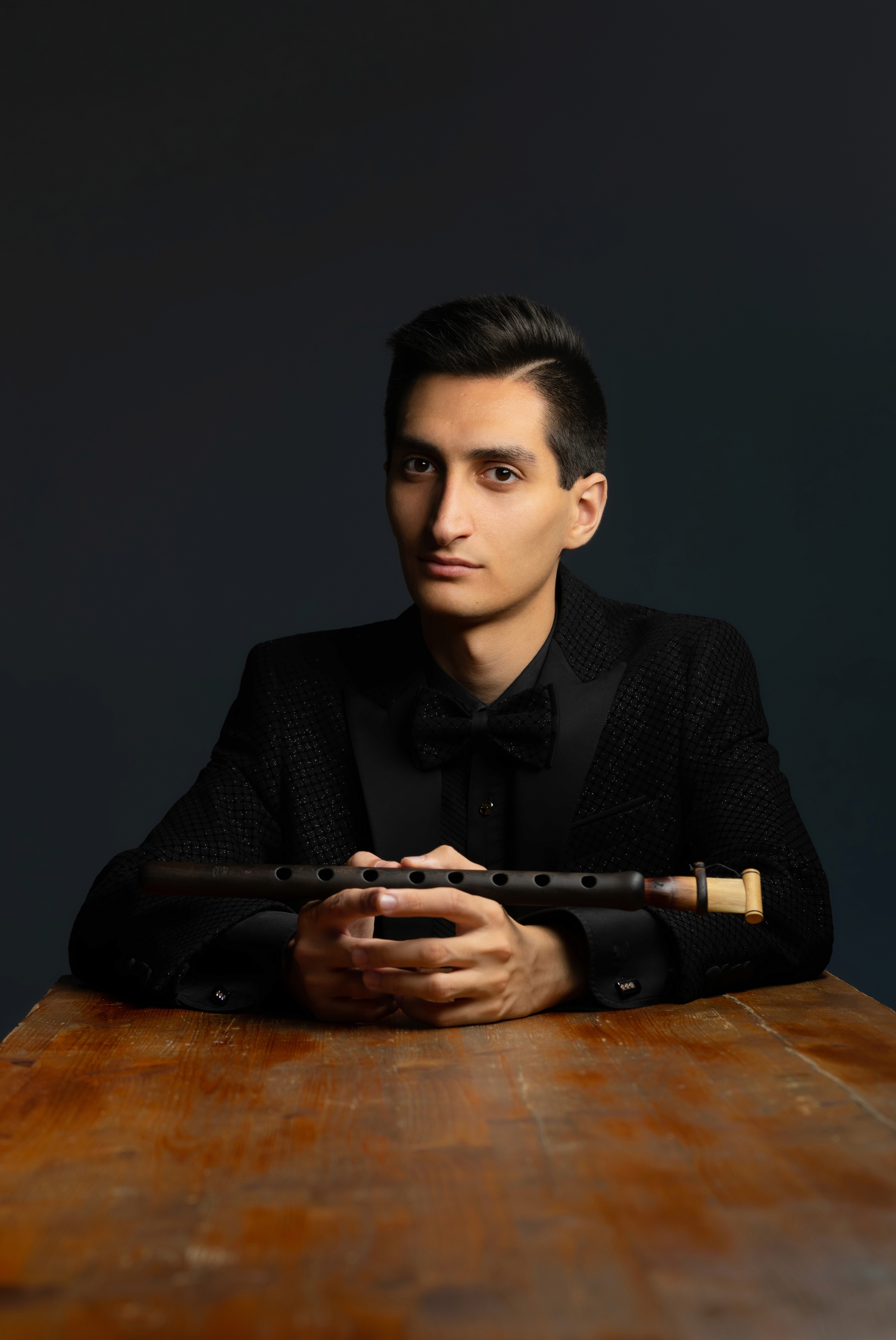
— According to a common stereotype, all Armenians begin playing the duduk almost from birth. But which instrument did you actually start with: the duduk or the clarinet?
— My first instrument was the clarinet after all (smiles). I have been involved in music since the age of four, when my parents enrolled me at the Blazhevich School, which specializes in training wind instrumentalists.
Like all wind players, I began with the recorder, although I had always dreamed of playing the piano. But that school was the closest one to our home, so fate decided that I would become a clarinetist. And you know, I do not regret it in the slightest. At the age of seven, I entered the Central Music School as a clarinet student, and I have lived in this professional environment ever since. At the same time, I always studied the piano with great enthusiasm.
Fate brought me to the duduk in 2019. At that time, the Armenian Assembly, with the tremendous support of Jivan Gasparyan, established an optional duduk class at the Gnessin School. That was where I began discovering the instrument under the guidance of the remarkable duduk player Armen Hovhannisyan. It is an immense honour to study with such a master.
I had always dreamed of playing the duduk. From the very first time I touched it, I understood that through this instrument I could express something special and reveal another side of myself—one that cannot be conveyed through classical music. These were completely different emotions, another kind of perception, and entirely new experiences for me. The instrument felt genuinely close to me, and it is a direction in which I want to continue developing.
— Did no one else in your family play the duduk?
— That would have been wonderful, but unfortunately I am the only musician in my family. Armenian culture has undoubtedly always lived within me, even though I was born in Moscow and my parents settled there many years ago. I am extremely grateful to my family. Despite living in a metropolis, they succeeded in preserving our traditions and culture. To a great extent, that is what shaped me.
— Is it difficult to combine performing on the clarinet and the duduk?
— I must admit that at first I was convinced that, after so many years of professional clarinet training, the duduk would present no real difficulty. It seemed to have a similar reed, although a different, double one. I thought I would spend a little time with it and everything would fall into place—especially because it was supposedly “in my blood.” But that was not the case.
Learning the duduk proved to be extremely demanding. It requires no less time than the clarinet: one must practise for several hours every day. Its complexity lies precisely in its apparent simplicity. The duduk is a very small instrument with a very large reed, which demands considerable physical effort as well as technical skill. It has no keys, so the fingers must move with complete freedom in order to produce every semitone.
Combining the two instruments is therefore challenging because they involve different techniques, different physical sensations and, naturally, completely different repertoires.
— There is a certain stereotypical image of a duduk player: a rather heavyset man with puffed-out cheeks and a prominent stomach. You are his complete opposite—slender and delicately built. How did your physique affect your mastery of circular breathing, which is so important for playing the duduk? And, in your opinion, is this technique more closely associated with jazz improvisation or with the classical tradition?
— I am always grateful to the clarinet for giving me a strong command of circular breathing. It is one of our fundamental techniques, required both in solo playing and in orchestral repertoire, where long, uninterrupted solos frequently occur.
Applying the same technique to the duduk is a very different and considerably more difficult challenge. As you noted, the instrument places enormous physical demands on the performer.
Many people do not understand why duduk players use their cheeks. Some even consider it a sign of unprofessional playing, as though the musician simply does not know another way to produce the sound. But the truth is that if you use the same embouchure as on the clarinet, either no sound will emerge at all or it will sound weak and impoverished. Without the correct technique, the duduk loses its characteristic depth and timbre.
Our responsibility as duduk players is to reveal the instrument’s full range of possibilities and allow it to sound as it truly should. This requires great physical effort, but I am holding on as best I can—I am not giving up, and so far I still have enough strength.
— How important is the material from which the instrument is made—apricot wood?
— Every duduk is made from this particular wood. It simply cannot be otherwise. Apricot wood is extremely fragile and temperamental. That is one explanation for why the instrument’s construction has not undergone further development. Nevertheless, I believe this contains more beauty than limitation.
— Do you believe that the wood “remembers” the Armenian sun?
— Yes—and the sweetness of the apricot as well (laughs).
— The duduk is undoubtedly a symbol of Armenian culture. Do you notice a growing international interest in it? Can we say that its popularity is gradually moving beyond national boundaries?
— I will resist being a stereotypical Armenian and claiming that Armenians invented everything in the world (smiles). It is gratifying to realize that this instrument has spread and developed over several centuries—not only in Armenia, but throughout many regions of the Middle East.
Today, an increasing number of people around the world are interested not only in Armenian culture, but in the instrument itself.
Every country has its own unique traditions. The duduk is also played in Iran, Palestine, Azerbaijan and Turkey, but in each of these places it has acquired distinct national characteristics, ornamentation and sonorities. In Europe, of course, the duduk is not as widespread. Those who play it generally have Eastern roots or possess a deep knowledge of the instrument, its music and its culture.
— You mentioned that you had always dreamed of becoming a pianist. We discovered an album of piano miniatures under your name on streaming platforms. Was this the fulfilment of that childhood dream, or a way of resolving unfinished business?
— I think recording that album could be described as unfinished business that still remains unresolved. I have never considered myself a pianist because I did not receive a formal professional piano education. But I sincerely love the instrument.
The piano became another means of self-expression for me. It allows me to communicate emotions that are difficult to convey through either the clarinet or the duduk. Each instrument reveals a new side of me and helps me tell a different part of my story.
— What kinds of emotions do you express through the piano, clarinet and duduk?
— To me, the clarinet is very close to the human voice. It is primarily a solo and fundamentally monophonic instrument. Its repertoire is beautiful, but nevertheless limited.
For example, I adore the music of Sergei Rachmaninoff. But the only works from his legacy that I can perform as a clarinet soloist are arrangements of songs or romances. The clarinet, like the duduk, has certain limitations.
At the piano, I search for the experiences that I cannot share through my other instruments. I try to expand the palette of my musical emotions and possibilities.
— According to a common stereotype, all Armenians begin playing the duduk almost from birth. But which instrument did you actually start with: the duduk or the clarinet?
— My first instrument was the clarinet after all (smiles). I have been involved in music since the age of four, when my parents enrolled me at the Blazhevich School, which specializes in training wind instrumentalists.
Like all wind players, I began with the recorder, although I had always dreamed of playing the piano. But that school was the closest one to our home, so fate decided that I would become a clarinetist. And you know, I do not regret it in the slightest. At the age of seven, I entered the Central Music School as a clarinet student, and I have lived in this professional environment ever since. At the same time, I always studied the piano with great enthusiasm.
Fate brought me to the duduk in 2019. At that time, the Armenian Assembly, with the tremendous support of Jivan Gasparyan, established an optional duduk class at the Gnessin School. That was where I began discovering the instrument under the guidance of the remarkable duduk player Armen Hovhannisyan. It is an immense honour to study with such a master.
I had always dreamed of playing the duduk. From the very first time I touched it, I understood that through this instrument I could express something special and reveal another side of myself—one that cannot be conveyed through classical music. These were completely different emotions, another kind of perception, and entirely new experiences for me. The instrument felt genuinely close to me, and it is a direction in which I want to continue developing.
— Did no one else in your family play the duduk?
— That would have been wonderful, but unfortunately I am the only musician in my family. Armenian culture has undoubtedly always lived within me, even though I was born in Moscow and my parents settled there many years ago. I am extremely grateful to my family. Despite living in a metropolis, they succeeded in preserving our traditions and culture. To a great extent, that is what shaped me.
— Is it difficult to combine performing on the clarinet and the duduk?
— I must admit that at first I was convinced that, after so many years of professional clarinet training, the duduk would present no real difficulty. It seemed to have a similar reed, although a different, double one. I thought I would spend a little time with it and everything would fall into place—especially because it was supposedly “in my blood.” But that was not the case.
Learning the duduk proved to be extremely demanding. It requires no less time than the clarinet: one must practise for several hours every day. Its complexity lies precisely in its apparent simplicity. The duduk is a very small instrument with a very large reed, which demands considerable physical effort as well as technical skill. It has no keys, so the fingers must move with complete freedom in order to produce every semitone.
Combining the two instruments is therefore challenging because they involve different techniques, different physical sensations and, naturally, completely different repertoires.
— There is a certain stereotypical image of a duduk player: a rather heavyset man with puffed-out cheeks and a prominent stomach. You are his complete opposite—slender and delicately built. How did your physique affect your mastery of circular breathing, which is so important for playing the duduk? And, in your opinion, is this technique more closely associated with jazz improvisation or with the classical tradition?
— I am always grateful to the clarinet for giving me a strong command of circular breathing. It is one of our fundamental techniques, required both in solo playing and in orchestral repertoire, where long, uninterrupted solos frequently occur.
Applying the same technique to the duduk is a very different and considerably more difficult challenge. As you noted, the instrument places enormous physical demands on the performer.
Many people do not understand why duduk players use their cheeks. Some even consider it a sign of unprofessional playing, as though the musician simply does not know another way to produce the sound. But the truth is that if you use the same embouchure as on the clarinet, either no sound will emerge at all or it will sound weak and impoverished. Without the correct technique, the duduk loses its characteristic depth and timbre.
Our responsibility as duduk players is to reveal the instrument’s full range of possibilities and allow it to sound as it truly should. This requires great physical effort, but I am holding on as best I can—I am not giving up, and so far I still have enough strength.
— How important is the material from which the instrument is made—apricot wood?
— Every duduk is made from this particular wood. It simply cannot be otherwise. Apricot wood is extremely fragile and temperamental. That is one explanation for why the instrument’s construction has not undergone further development. Nevertheless, I believe this contains more beauty than limitation.
— Do you believe that the wood “remembers” the Armenian sun?
— Yes—and the sweetness of the apricot as well (laughs).
— The duduk is undoubtedly a symbol of Armenian culture. Do you notice a growing international interest in it? Can we say that its popularity is gradually moving beyond national boundaries?
— I will resist being a stereotypical Armenian and claiming that Armenians invented everything in the world (smiles). It is gratifying to realize that this instrument has spread and developed over several centuries—not only in Armenia, but throughout many regions of the Middle East.
Today, an increasing number of people around the world are interested not only in Armenian culture, but in the instrument itself.
Every country has its own unique traditions. The duduk is also played in Iran, Palestine, Azerbaijan and Turkey, but in each of these places it has acquired distinct national characteristics, ornamentation and sonorities. In Europe, of course, the duduk is not as widespread. Those who play it generally have Eastern roots or possess a deep knowledge of the instrument, its music and its culture.
— You mentioned that you had always dreamed of becoming a pianist. We discovered an album of piano miniatures under your name on streaming platforms. Was this the fulfilment of that childhood dream, or a way of resolving unfinished business?
— I think recording that album could be described as unfinished business that still remains unresolved. I have never considered myself a pianist because I did not receive a formal professional piano education. But I sincerely love the instrument.
The piano became another means of self-expression for me. It allows me to communicate emotions that are difficult to convey through either the clarinet or the duduk. Each instrument reveals a new side of me and helps me tell a different part of my story.
— What kinds of emotions do you express through the piano, clarinet and duduk?
— To me, the clarinet is very close to the human voice. It is primarily a solo and fundamentally monophonic instrument. Its repertoire is beautiful, but nevertheless limited.
For example, I adore the music of Sergei Rachmaninoff. But the only works from his legacy that I can perform as a clarinet soloist are arrangements of songs or romances. The clarinet, like the duduk, has certain limitations.
At the piano, I search for the experiences that I cannot share through my other instruments. I try to expand the palette of my musical emotions and possibilities.
— According to a common stereotype, all Armenians begin playing the duduk almost from birth. But which instrument did you actually start with: the duduk or the clarinet?
— My first instrument was the clarinet after all (smiles). I have been involved in music since the age of four, when my parents enrolled me at the Blazhevich School, which specializes in training wind instrumentalists.
Like all wind players, I began with the recorder, although I had always dreamed of playing the piano. But that school was the closest one to our home, so fate decided that I would become a clarinetist. And you know, I do not regret it in the slightest. At the age of seven, I entered the Central Music School as a clarinet student, and I have lived in this professional environment ever since. At the same time, I always studied the piano with great enthusiasm.
Fate brought me to the duduk in 2019. At that time, the Armenian Assembly, with the tremendous support of Jivan Gasparyan, established an optional duduk class at the Gnessin School. That was where I began discovering the instrument under the guidance of the remarkable duduk player Armen Hovhannisyan. It is an immense honour to study with such a master.
I had always dreamed of playing the duduk. From the very first time I touched it, I understood that through this instrument I could express something special and reveal another side of myself—one that cannot be conveyed through classical music. These were completely different emotions, another kind of perception, and entirely new experiences for me. The instrument felt genuinely close to me, and it is a direction in which I want to continue developing.
— Did no one else in your family play the duduk?
— That would have been wonderful, but unfortunately I am the only musician in my family. Armenian culture has undoubtedly always lived within me, even though I was born in Moscow and my parents settled there many years ago. I am extremely grateful to my family. Despite living in a metropolis, they succeeded in preserving our traditions and culture. To a great extent, that is what shaped me.
— Is it difficult to combine performing on the clarinet and the duduk?
— I must admit that at first I was convinced that, after so many years of professional clarinet training, the duduk would present no real difficulty. It seemed to have a similar reed, although a different, double one. I thought I would spend a little time with it and everything would fall into place—especially because it was supposedly “in my blood.” But that was not the case.
Learning the duduk proved to be extremely demanding. It requires no less time than the clarinet: one must practise for several hours every day. Its complexity lies precisely in its apparent simplicity. The duduk is a very small instrument with a very large reed, which demands considerable physical effort as well as technical skill. It has no keys, so the fingers must move with complete freedom in order to produce every semitone.
Combining the two instruments is therefore challenging because they involve different techniques, different physical sensations and, naturally, completely different repertoires.
— There is a certain stereotypical image of a duduk player: a rather heavyset man with puffed-out cheeks and a prominent stomach. You are his complete opposite—slender and delicately built. How did your physique affect your mastery of circular breathing, which is so important for playing the duduk? And, in your opinion, is this technique more closely associated with jazz improvisation or with the classical tradition?
— I am always grateful to the clarinet for giving me a strong command of circular breathing. It is one of our fundamental techniques, required both in solo playing and in orchestral repertoire, where long, uninterrupted solos frequently occur.
Applying the same technique to the duduk is a very different and considerably more difficult challenge. As you noted, the instrument places enormous physical demands on the performer.
Many people do not understand why duduk players use their cheeks. Some even consider it a sign of unprofessional playing, as though the musician simply does not know another way to produce the sound. But the truth is that if you use the same embouchure as on the clarinet, either no sound will emerge at all or it will sound weak and impoverished. Without the correct technique, the duduk loses its characteristic depth and timbre.
Our responsibility as duduk players is to reveal the instrument’s full range of possibilities and allow it to sound as it truly should. This requires great physical effort, but I am holding on as best I can—I am not giving up, and so far I still have enough strength.
— How important is the material from which the instrument is made—apricot wood?
— Every duduk is made from this particular wood. It simply cannot be otherwise. Apricot wood is extremely fragile and temperamental. That is one explanation for why the instrument’s construction has not undergone further development. Nevertheless, I believe this contains more beauty than limitation.
— Do you believe that the wood “remembers” the Armenian sun?
— Yes—and the sweetness of the apricot as well (laughs).
— The duduk is undoubtedly a symbol of Armenian culture. Do you notice a growing international interest in it? Can we say that its popularity is gradually moving beyond national boundaries?
— I will resist being a stereotypical Armenian and claiming that Armenians invented everything in the world (smiles). It is gratifying to realize that this instrument has spread and developed over several centuries—not only in Armenia, but throughout many regions of the Middle East.
Today, an increasing number of people around the world are interested not only in Armenian culture, but in the instrument itself.
Every country has its own unique traditions. The duduk is also played in Iran, Palestine, Azerbaijan and Turkey, but in each of these places it has acquired distinct national characteristics, ornamentation and sonorities. In Europe, of course, the duduk is not as widespread. Those who play it generally have Eastern roots or possess a deep knowledge of the instrument, its music and its culture.
— You mentioned that you had always dreamed of becoming a pianist. We discovered an album of piano miniatures under your name on streaming platforms. Was this the fulfilment of that childhood dream, or a way of resolving unfinished business?
— I think recording that album could be described as unfinished business that still remains unresolved. I have never considered myself a pianist because I did not receive a formal professional piano education. But I sincerely love the instrument.
The piano became another means of self-expression for me. It allows me to communicate emotions that are difficult to convey through either the clarinet or the duduk. Each instrument reveals a new side of me and helps me tell a different part of my story.
— What kinds of emotions do you express through the piano, clarinet and duduk?
— To me, the clarinet is very close to the human voice. It is primarily a solo and fundamentally monophonic instrument. Its repertoire is beautiful, but nevertheless limited.
For example, I adore the music of Sergei Rachmaninoff. But the only works from his legacy that I can perform as a clarinet soloist are arrangements of songs or romances. The clarinet, like the duduk, has certain limitations.
At the piano, I search for the experiences that I cannot share through my other instruments. I try to expand the palette of my musical emotions and possibilities.
— There is a noticeable tendency in today’s musical world for young performers to pursue a second degree—in conducting or composition, for example. Are you not tempted to obtain that coveted piano diploma and formalize your relationship with the instrument?
— I thought about that for a very long time. Eventually, I realized that, broadly speaking, nothing and no one prevents me from receiving that education “unofficially.”
I have been exceptionally fortunate with my teachers. At the Moscow Conservatory, I study the Russian piano school with Tatiana Tarasevich-Nikolaeva. In Berlin, I study with Zinaida Weissman, who carries forward both Russian and German musical traditions, including the Neuhaus tradition.
My teachers support me and help me in every possible way. Thanks to them, I am able to work on highly demanding repertoire and continue developing.
— Tell us about your new album, Reflections. Why are so many of its compositions filled with sorrow?
— The duduk frequently expresses sorrowful emotions, and I believe this is connected to the history of the Armenian people. It is an extraordinarily ancient instrument, with a history extending back more than fifteen centuries. So much has happened during that time, and the duduk has witnessed all of it.
For the album, I chose very ancient melodies. They were passed down orally from generation to generation, making it almost impossible to determine when they first appeared. I set myself the task of bringing this ancient musical layer closer to the present.
I wanted this music to reach a broad audience, just as pop music, Baroque music and contemporary compositions do.
Observing the tremendous interest that the duduk inspires among audiences and non-specialist listeners, I began asking myself why the instrument affects them so deeply. People hearing it for the first time almost always experience the same emotion—a mixture of sorrow and healing. It is astonishing.
I explored this question seriously and arrived at the conclusion that one does not need to speak Armenian or know the history of Armenia in order to understand this music. After all, even within the classical tradition, we possess no absolute understanding of what constitutes the “correct” interpretation of a classical work.
When engaging with the duduk, everything depends on inner feeling, the perception of the soul and an understanding of the spirit of the people. Guided by that feeling, we recreate the music, and that is why it continues to resonate in people’s hearts.
Ultimately, despite the differences between our countries, cultures and memories, we are united by simple things: childhood, language, scents and food. I have the feeling that the sound of the duduk emerges from the very depths of time, from some shared source.
It unites us not by telling everyone the same story, but because each person discovers something of their own within it—a personal story or memory.
— The duduk’s timbre is often described as “mysterious” or “enchanting,” and the instrument is frequently associated with relaxation music. As a representative of Armenian culture, do such comparisons trouble you?
— Those descriptions did not become established by accident, and I completely agree with them (smiles). The duduk truly expresses the soul itself. It is such a simple and sincere instrument that any trace of falseness immediately becomes apparent.
For me as an artist, it is essential to remain emotionally honest with myself and with the audience.
I believe the duduk conveys that sincerity perfectly, creating an immediate connection with the listener. Much of this comes from the meditative aura of the instrument. When listening to it, it is easy to turn inward and reflect upon something personal, even if it has no direct connection to the story behind the composition.
Perhaps that is precisely what music of the soul means: it allows every person to encounter their own feelings and memories.
— In your new album, you bring the duduk closer to the contemporary world.
— For me, bringing something contemporary into ancient music means contributing my own understanding and vision.
As a performer, I have the right to do this because this music was never definitively fixed by its creators. For example, the two accompanied tracks on my album feature my own arrangements. I devised the ornamentation and melodic variations myself, as these are individual to every duduk player.
Our tradition therefore has no single, definitive version of a composition that must always be performed in one prescribed way. We do not follow written notes literally. Instead, we inherit a kind of melodic skeleton, which we then bring to life, transform and fill with our own soul.
— You are also a composer.
— I love composing music. However, because most of my life is devoted to performing, I simply do not have as much time as I would like to immerse myself fully in composition.
Nevertheless, I have already written a number of works, including chamber and vocal compositions. I work in different styles—not only in classical music, but in popular music as well.
Naturally, Armenian themes and a distinctive Armenian colour are also present in my work. Perhaps my next great dream will be to create an album of original compositions devoted entirely to Armenian music.
— What stories do the compositions on your album tell?
— The album concludes with the song “Havun, Havun,” which dates from approximately the tenth century. This chant was performed in church during Easter celebrations and is connected with the Resurrection.
It is a very luminous prayer, and it seemed to me an appropriate conclusion to the album—a hope for continuation. The other compositions speak of love, sorrow and tragedy.
The opening track, for example, is dedicated to the memory of the victims of the Armenian Genocide. That is why it contains such piercing pain and such a profound sense of the loss of millions of lives.
It is music about the eternal. I would describe it as the quintessence of hope and sorrow. This track is extremely important to me because it concerns my people, who endured unimaginable trials but found the strength to survive—not with bitterness, but with peace in their souls, preserving their culture, language, love and faith.
— You combine the authentic sound of the duduk with contemporary arrangements. On the album Samsara Passengers, for example, the duduk appears within an electronic sound world.
— It was an interesting coincidence: my “folk” album was released on the same day as my collaboration with Øneheart, an artist known for his work in ambient music. He is a wonderful musician with a distinctive creative voice.
The concept behind his album was to unite the cultural heritage of different countries with contemporary electronic music. I was given complete freedom to compose the duduk solo for “Shifting Sands,” the track that opens the album.
This allowed me to connect the ancient instrument with contemporary music as well. I worked on the arrangement together with the wonderful producer Konstantin Korsakov, known as Dean Korso. It was a fascinating experience.
— Have you already performed as a duduk player in ensembles?
— From time to time, my friends and I experiment with different combinations of instruments. Most recently, on 5 October, the cellist Anastasia Ushakova and I performed several tracks from my album in an intimate chamber setting.
This was especially meaningful to us because we studied together at the Central Music School and continued our studies at the Moscow Conservatory. We had always wanted to combine the cello and the duduk—two ancient instruments with rich histories.
Paradoxically, that concert also marked the opening of the Cello Academy. I sincerely hope that the organization Nastya founded will influence the future of classical music in Russia and beyond.
At the opening, we performed that same prayer, “Havun, Havun,” thereby blessing the Academy with a long and happy life (smiles).
— Do you separate your two identities: “Erik the clarinetist” and “Erik the duduk player”?
— There is a noticeable tendency in today’s musical world for young performers to pursue a second degree—in conducting or composition, for example. Are you not tempted to obtain that coveted piano diploma and formalize your relationship with the instrument?
— I thought about that for a very long time. Eventually, I realized that, broadly speaking, nothing and no one prevents me from receiving that education “unofficially.”
I have been exceptionally fortunate with my teachers. At the Moscow Conservatory, I study the Russian piano school with Tatiana Tarasevich-Nikolaeva. In Berlin, I study with Zinaida Weissman, who carries forward both Russian and German musical traditions, including the Neuhaus tradition.
My teachers support me and help me in every possible way. Thanks to them, I am able to work on highly demanding repertoire and continue developing.
— Tell us about your new album, Reflections. Why are so many of its compositions filled with sorrow?
— The duduk frequently expresses sorrowful emotions, and I believe this is connected to the history of the Armenian people. It is an extraordinarily ancient instrument, with a history extending back more than fifteen centuries. So much has happened during that time, and the duduk has witnessed all of it.
For the album, I chose very ancient melodies. They were passed down orally from generation to generation, making it almost impossible to determine when they first appeared. I set myself the task of bringing this ancient musical layer closer to the present.
I wanted this music to reach a broad audience, just as pop music, Baroque music and contemporary compositions do.
Observing the tremendous interest that the duduk inspires among audiences and non-specialist listeners, I began asking myself why the instrument affects them so deeply. People hearing it for the first time almost always experience the same emotion—a mixture of sorrow and healing. It is astonishing.
I explored this question seriously and arrived at the conclusion that one does not need to speak Armenian or know the history of Armenia in order to understand this music. After all, even within the classical tradition, we possess no absolute understanding of what constitutes the “correct” interpretation of a classical work.
When engaging with the duduk, everything depends on inner feeling, the perception of the soul and an understanding of the spirit of the people. Guided by that feeling, we recreate the music, and that is why it continues to resonate in people’s hearts.
Ultimately, despite the differences between our countries, cultures and memories, we are united by simple things: childhood, language, scents and food. I have the feeling that the sound of the duduk emerges from the very depths of time, from some shared source.
It unites us not by telling everyone the same story, but because each person discovers something of their own within it—a personal story or memory.
— The duduk’s timbre is often described as “mysterious” or “enchanting,” and the instrument is frequently associated with relaxation music. As a representative of Armenian culture, do such comparisons trouble you?
— Those descriptions did not become established by accident, and I completely agree with them (smiles). The duduk truly expresses the soul itself. It is such a simple and sincere instrument that any trace of falseness immediately becomes apparent.
For me as an artist, it is essential to remain emotionally honest with myself and with the audience.
I believe the duduk conveys that sincerity perfectly, creating an immediate connection with the listener. Much of this comes from the meditative aura of the instrument. When listening to it, it is easy to turn inward and reflect upon something personal, even if it has no direct connection to the story behind the composition.
Perhaps that is precisely what music of the soul means: it allows every person to encounter their own feelings and memories.
— In your new album, you bring the duduk closer to the contemporary world.
— For me, bringing something contemporary into ancient music means contributing my own understanding and vision.
As a performer, I have the right to do this because this music was never definitively fixed by its creators. For example, the two accompanied tracks on my album feature my own arrangements. I devised the ornamentation and melodic variations myself, as these are individual to every duduk player.
Our tradition therefore has no single, definitive version of a composition that must always be performed in one prescribed way. We do not follow written notes literally. Instead, we inherit a kind of melodic skeleton, which we then bring to life, transform and fill with our own soul.
— You are also a composer.
— I love composing music. However, because most of my life is devoted to performing, I simply do not have as much time as I would like to immerse myself fully in composition.
Nevertheless, I have already written a number of works, including chamber and vocal compositions. I work in different styles—not only in classical music, but in popular music as well.
Naturally, Armenian themes and a distinctive Armenian colour are also present in my work. Perhaps my next great dream will be to create an album of original compositions devoted entirely to Armenian music.
— What stories do the compositions on your album tell?
— The album concludes with the song “Havun, Havun,” which dates from approximately the tenth century. This chant was performed in church during Easter celebrations and is connected with the Resurrection.
It is a very luminous prayer, and it seemed to me an appropriate conclusion to the album—a hope for continuation. The other compositions speak of love, sorrow and tragedy.
The opening track, for example, is dedicated to the memory of the victims of the Armenian Genocide. That is why it contains such piercing pain and such a profound sense of the loss of millions of lives.
It is music about the eternal. I would describe it as the quintessence of hope and sorrow. This track is extremely important to me because it concerns my people, who endured unimaginable trials but found the strength to survive—not with bitterness, but with peace in their souls, preserving their culture, language, love and faith.
— You combine the authentic sound of the duduk with contemporary arrangements. On the album Samsara Passengers, for example, the duduk appears within an electronic sound world.
— It was an interesting coincidence: my “folk” album was released on the same day as my collaboration with Øneheart, an artist known for his work in ambient music. He is a wonderful musician with a distinctive creative voice.
The concept behind his album was to unite the cultural heritage of different countries with contemporary electronic music. I was given complete freedom to compose the duduk solo for “Shifting Sands,” the track that opens the album.
This allowed me to connect the ancient instrument with contemporary music as well. I worked on the arrangement together with the wonderful producer Konstantin Korsakov, known as Dean Korso. It was a fascinating experience.
— Have you already performed as a duduk player in ensembles?
— From time to time, my friends and I experiment with different combinations of instruments. Most recently, on 5 October, the cellist Anastasia Ushakova and I performed several tracks from my album in an intimate chamber setting.
This was especially meaningful to us because we studied together at the Central Music School and continued our studies at the Moscow Conservatory. We had always wanted to combine the cello and the duduk—two ancient instruments with rich histories.
Paradoxically, that concert also marked the opening of the Cello Academy. I sincerely hope that the organization Nastya founded will influence the future of classical music in Russia and beyond.
At the opening, we performed that same prayer, “Havun, Havun,” thereby blessing the Academy with a long and happy life (smiles).
— Do you separate your two identities: “Erik the clarinetist” and “Erik the duduk player”?
— There is a noticeable tendency in today’s musical world for young performers to pursue a second degree—in conducting or composition, for example. Are you not tempted to obtain that coveted piano diploma and formalize your relationship with the instrument?
— I thought about that for a very long time. Eventually, I realized that, broadly speaking, nothing and no one prevents me from receiving that education “unofficially.”
I have been exceptionally fortunate with my teachers. At the Moscow Conservatory, I study the Russian piano school with Tatiana Tarasevich-Nikolaeva. In Berlin, I study with Zinaida Weissman, who carries forward both Russian and German musical traditions, including the Neuhaus tradition.
My teachers support me and help me in every possible way. Thanks to them, I am able to work on highly demanding repertoire and continue developing.
— Tell us about your new album, Reflections. Why are so many of its compositions filled with sorrow?
— The duduk frequently expresses sorrowful emotions, and I believe this is connected to the history of the Armenian people. It is an extraordinarily ancient instrument, with a history extending back more than fifteen centuries. So much has happened during that time, and the duduk has witnessed all of it.
For the album, I chose very ancient melodies. They were passed down orally from generation to generation, making it almost impossible to determine when they first appeared. I set myself the task of bringing this ancient musical layer closer to the present.
I wanted this music to reach a broad audience, just as pop music, Baroque music and contemporary compositions do.
Observing the tremendous interest that the duduk inspires among audiences and non-specialist listeners, I began asking myself why the instrument affects them so deeply. People hearing it for the first time almost always experience the same emotion—a mixture of sorrow and healing. It is astonishing.
I explored this question seriously and arrived at the conclusion that one does not need to speak Armenian or know the history of Armenia in order to understand this music. After all, even within the classical tradition, we possess no absolute understanding of what constitutes the “correct” interpretation of a classical work.
When engaging with the duduk, everything depends on inner feeling, the perception of the soul and an understanding of the spirit of the people. Guided by that feeling, we recreate the music, and that is why it continues to resonate in people’s hearts.
Ultimately, despite the differences between our countries, cultures and memories, we are united by simple things: childhood, language, scents and food. I have the feeling that the sound of the duduk emerges from the very depths of time, from some shared source.
It unites us not by telling everyone the same story, but because each person discovers something of their own within it—a personal story or memory.
— The duduk’s timbre is often described as “mysterious” or “enchanting,” and the instrument is frequently associated with relaxation music. As a representative of Armenian culture, do such comparisons trouble you?
— Those descriptions did not become established by accident, and I completely agree with them (smiles). The duduk truly expresses the soul itself. It is such a simple and sincere instrument that any trace of falseness immediately becomes apparent.
For me as an artist, it is essential to remain emotionally honest with myself and with the audience.
I believe the duduk conveys that sincerity perfectly, creating an immediate connection with the listener. Much of this comes from the meditative aura of the instrument. When listening to it, it is easy to turn inward and reflect upon something personal, even if it has no direct connection to the story behind the composition.
Perhaps that is precisely what music of the soul means: it allows every person to encounter their own feelings and memories.
— In your new album, you bring the duduk closer to the contemporary world.
— For me, bringing something contemporary into ancient music means contributing my own understanding and vision.
As a performer, I have the right to do this because this music was never definitively fixed by its creators. For example, the two accompanied tracks on my album feature my own arrangements. I devised the ornamentation and melodic variations myself, as these are individual to every duduk player.
Our tradition therefore has no single, definitive version of a composition that must always be performed in one prescribed way. We do not follow written notes literally. Instead, we inherit a kind of melodic skeleton, which we then bring to life, transform and fill with our own soul.
— You are also a composer.
— I love composing music. However, because most of my life is devoted to performing, I simply do not have as much time as I would like to immerse myself fully in composition.
Nevertheless, I have already written a number of works, including chamber and vocal compositions. I work in different styles—not only in classical music, but in popular music as well.
Naturally, Armenian themes and a distinctive Armenian colour are also present in my work. Perhaps my next great dream will be to create an album of original compositions devoted entirely to Armenian music.
— What stories do the compositions on your album tell?
— The album concludes with the song “Havun, Havun,” which dates from approximately the tenth century. This chant was performed in church during Easter celebrations and is connected with the Resurrection.
It is a very luminous prayer, and it seemed to me an appropriate conclusion to the album—a hope for continuation. The other compositions speak of love, sorrow and tragedy.
The opening track, for example, is dedicated to the memory of the victims of the Armenian Genocide. That is why it contains such piercing pain and such a profound sense of the loss of millions of lives.
It is music about the eternal. I would describe it as the quintessence of hope and sorrow. This track is extremely important to me because it concerns my people, who endured unimaginable trials but found the strength to survive—not with bitterness, but with peace in their souls, preserving their culture, language, love and faith.
— You combine the authentic sound of the duduk with contemporary arrangements. On the album Samsara Passengers, for example, the duduk appears within an electronic sound world.
— It was an interesting coincidence: my “folk” album was released on the same day as my collaboration with Øneheart, an artist known for his work in ambient music. He is a wonderful musician with a distinctive creative voice.
The concept behind his album was to unite the cultural heritage of different countries with contemporary electronic music. I was given complete freedom to compose the duduk solo for “Shifting Sands,” the track that opens the album.
This allowed me to connect the ancient instrument with contemporary music as well. I worked on the arrangement together with the wonderful producer Konstantin Korsakov, known as Dean Korso. It was a fascinating experience.
— Have you already performed as a duduk player in ensembles?
— From time to time, my friends and I experiment with different combinations of instruments. Most recently, on 5 October, the cellist Anastasia Ushakova and I performed several tracks from my album in an intimate chamber setting.
This was especially meaningful to us because we studied together at the Central Music School and continued our studies at the Moscow Conservatory. We had always wanted to combine the cello and the duduk—two ancient instruments with rich histories.
Paradoxically, that concert also marked the opening of the Cello Academy. I sincerely hope that the organization Nastya founded will influence the future of classical music in Russia and beyond.
At the opening, we performed that same prayer, “Havun, Havun,” thereby blessing the Academy with a long and happy life (smiles).
— Do you separate your two identities: “Erik the clarinetist” and “Erik the duduk player”?
— I present myself first and foremost as a musician. Nevertheless, I do distinguish between the two instruments. Their traditions, sound worlds and repertoires are completely different.
Every day, I learn from myself. In classical music, it is essential to invest every bar with meaning; with the duduk, one must return to the very beginning—to one’s origins and roots.
Naturally, it is important not to overdo either approach. But overall, these two directions do not contradict each other. They complement one another harmoniously.
— In Russia, audiences readily attend chamber performances by violinists and pianists. Interest in solo recitals by wind players, however, is considerably smaller. Do you believe the solo clarinet has a future on the classical stage?
— That is a wonderful question. Perhaps my principal goal—even my mission—is to change the position of wind instruments within the musical world.
The problem is not a lack of repertoire or talented performers, but insufficient attention from presenters and agents. I want to demonstrate how fascinating and versatile wind instruments can be. One can listen to them for hours and discover music to suit every taste and every genre.
As far as the clarinet is concerned, building a solo career in Russia is not easy. Personally, I do not divide my identity into separate solo and orchestral roles. Performing in an orchestra or ensemble is extraordinarily demanding work that requires the highest level of mastery.
Wind players are always soloists within an orchestra because our parts are often prominent, expressive and musically rich.
— Nevertheless, which is closer to you: working within an ensemble or meeting an audience alone from the stage?
— In Russia and in the West, there is a stereotype that a soloist should do nothing else—that their time supposedly belongs entirely to touring and recording. And if that is the case, how could they possibly find time to perform in an orchestra?
To some extent, this reasoning is understandable, but I believe it is ultimately a question of priorities. I genuinely enjoy both, and I want to break down the wall between these two professions.
I want to demonstrate that soloists can be universal musicians who retain their individuality wherever they may be—whether inside an ensemble or alone on a great stage.
— How does orchestral and ensemble experience influence your solo playing?
— It changes the way you think and reveals music from another perspective. You learn to play not only technically and not only with your mind, but also “with your ears”—to hear everything taking place around you.
I try to apply this experience to each of my instruments because it significantly improves the quality of the performance.
— You study in Germany with Matthias Glander, principal clarinetist of the Staatsoper Unter den Linden. What is the European school of wind playing like, and how does it differ from the Russian tradition?
— In my opinion, the Russian school of music is the strongest in the world. I was fortunate to study in Moscow, where an extraordinarily solid foundation is established, especially during childhood education.
However, after the age of twenty, many musicians—including wind players—find themselves without clear professional prospects. This is precisely where Anastasia Ushakova’s initiative plays an important role. She is creating opportunities for conservatory graduates to establish themselves during this transitional period by participating in competitions, interesting projects and masterclasses.
The Russian school is a “school of life”: it is defined by strictness, attention to detail and a deeply serious attitude towards the profession.
In Europe, students are often treated too much like pupils, which can slow their professional development—particularly for wind players, whose careers are frequently viewed as being limited to orchestral work.
I am now grateful for the opportunity to take the best from both educational systems. The Russian school is distinguished by its profound understanding of music, while the European school offers freedom of interpretation and openness to new approaches.
Combining these traditions is a difficult but rewarding task. It allows me to discover my own “golden mean” in music.
— Who represents the ideal among clarinetists for you?
— I would not name any performer whose playing I consider the single correct standard. Perhaps this comes from my desire to take the instrument to a new level—something that cannot be achieved by following only one interpretation, one vision or one concept of sound.
Music is not a museum object. It must continue to develop while remaining free within the framework of tradition.
For that reason, I do not have one ideal. I have only the aspiration to advance the instrument and make it genuinely popular.
— Are you planning to learn any new instruments? Perhaps the cello, with Anastasia Ushakova’s help?
— I am endlessly grateful to Nastya, but I am afraid she would not have enough patience for me (laughs).
Although I am a very diligent student, my three instruments are entirely sufficient for me at present. The possibilities they offer for creativity and experimentation seem limitless.
— What is currently in your playlist?
— I am an insatiable music lover. My taste is extremely varied—from jazz and pop music to works by friends of mine who are only beginning their journeys as composers.
For me, listening to music is a way of remaining aware of everything that is happening, discovering new things and drawing inspiration from them. It helps me develop as a person and shape my own sound.
— One final question: if you had to keep only one instrument—the clarinet, duduk or piano—which would you choose?
— In that case, it would be easier to leave music altogether (smiles). It is a choice I could never make.
Each instrument is a part of me. Losing any one of them would be like losing an arm or a leg. I would probably lose my mind if I were forced simply to remove one of them from my life.
Interview by Anna Kolomoets
— I present myself first and foremost as a musician. Nevertheless, I do distinguish between the two instruments. Their traditions, sound worlds and repertoires are completely different.
Every day, I learn from myself. In classical music, it is essential to invest every bar with meaning; with the duduk, one must return to the very beginning—to one’s origins and roots.
Naturally, it is important not to overdo either approach. But overall, these two directions do not contradict each other. They complement one another harmoniously.
— In Russia, audiences readily attend chamber performances by violinists and pianists. Interest in solo recitals by wind players, however, is considerably smaller. Do you believe the solo clarinet has a future on the classical stage?
— That is a wonderful question. Perhaps my principal goal—even my mission—is to change the position of wind instruments within the musical world.
The problem is not a lack of repertoire or talented performers, but insufficient attention from presenters and agents. I want to demonstrate how fascinating and versatile wind instruments can be. One can listen to them for hours and discover music to suit every taste and every genre.
As far as the clarinet is concerned, building a solo career in Russia is not easy. Personally, I do not divide my identity into separate solo and orchestral roles. Performing in an orchestra or ensemble is extraordinarily demanding work that requires the highest level of mastery.
Wind players are always soloists within an orchestra because our parts are often prominent, expressive and musically rich.
— Nevertheless, which is closer to you: working within an ensemble or meeting an audience alone from the stage?
— In Russia and in the West, there is a stereotype that a soloist should do nothing else—that their time supposedly belongs entirely to touring and recording. And if that is the case, how could they possibly find time to perform in an orchestra?
To some extent, this reasoning is understandable, but I believe it is ultimately a question of priorities. I genuinely enjoy both, and I want to break down the wall between these two professions.
I want to demonstrate that soloists can be universal musicians who retain their individuality wherever they may be—whether inside an ensemble or alone on a great stage.
— How does orchestral and ensemble experience influence your solo playing?
— It changes the way you think and reveals music from another perspective. You learn to play not only technically and not only with your mind, but also “with your ears”—to hear everything taking place around you.
I try to apply this experience to each of my instruments because it significantly improves the quality of the performance.
— You study in Germany with Matthias Glander, principal clarinetist of the Staatsoper Unter den Linden. What is the European school of wind playing like, and how does it differ from the Russian tradition?
— In my opinion, the Russian school of music is the strongest in the world. I was fortunate to study in Moscow, where an extraordinarily solid foundation is established, especially during childhood education.
However, after the age of twenty, many musicians—including wind players—find themselves without clear professional prospects. This is precisely where Anastasia Ushakova’s initiative plays an important role. She is creating opportunities for conservatory graduates to establish themselves during this transitional period by participating in competitions, interesting projects and masterclasses.
The Russian school is a “school of life”: it is defined by strictness, attention to detail and a deeply serious attitude towards the profession.
In Europe, students are often treated too much like pupils, which can slow their professional development—particularly for wind players, whose careers are frequently viewed as being limited to orchestral work.
I am now grateful for the opportunity to take the best from both educational systems. The Russian school is distinguished by its profound understanding of music, while the European school offers freedom of interpretation and openness to new approaches.
Combining these traditions is a difficult but rewarding task. It allows me to discover my own “golden mean” in music.
— Who represents the ideal among clarinetists for you?
— I would not name any performer whose playing I consider the single correct standard. Perhaps this comes from my desire to take the instrument to a new level—something that cannot be achieved by following only one interpretation, one vision or one concept of sound.
Music is not a museum object. It must continue to develop while remaining free within the framework of tradition.
For that reason, I do not have one ideal. I have only the aspiration to advance the instrument and make it genuinely popular.
— Are you planning to learn any new instruments? Perhaps the cello, with Anastasia Ushakova’s help?
— I am endlessly grateful to Nastya, but I am afraid she would not have enough patience for me (laughs).
Although I am a very diligent student, my three instruments are entirely sufficient for me at present. The possibilities they offer for creativity and experimentation seem limitless.
— What is currently in your playlist?
— I am an insatiable music lover. My taste is extremely varied—from jazz and pop music to works by friends of mine who are only beginning their journeys as composers.
For me, listening to music is a way of remaining aware of everything that is happening, discovering new things and drawing inspiration from them. It helps me develop as a person and shape my own sound.
— One final question: if you had to keep only one instrument—the clarinet, duduk or piano—which would you choose?
— In that case, it would be easier to leave music altogether (smiles). It is a choice I could never make.
Each instrument is a part of me. Losing any one of them would be like losing an arm or a leg. I would probably lose my mind if I were forced simply to remove one of them from my life.
Interview by Anna Kolomoets
— I present myself first and foremost as a musician. Nevertheless, I do distinguish between the two instruments. Their traditions, sound worlds and repertoires are completely different.
Every day, I learn from myself. In classical music, it is essential to invest every bar with meaning; with the duduk, one must return to the very beginning—to one’s origins and roots.
Naturally, it is important not to overdo either approach. But overall, these two directions do not contradict each other. They complement one another harmoniously.
— In Russia, audiences readily attend chamber performances by violinists and pianists. Interest in solo recitals by wind players, however, is considerably smaller. Do you believe the solo clarinet has a future on the classical stage?
— That is a wonderful question. Perhaps my principal goal—even my mission—is to change the position of wind instruments within the musical world.
The problem is not a lack of repertoire or talented performers, but insufficient attention from presenters and agents. I want to demonstrate how fascinating and versatile wind instruments can be. One can listen to them for hours and discover music to suit every taste and every genre.
As far as the clarinet is concerned, building a solo career in Russia is not easy. Personally, I do not divide my identity into separate solo and orchestral roles. Performing in an orchestra or ensemble is extraordinarily demanding work that requires the highest level of mastery.
Wind players are always soloists within an orchestra because our parts are often prominent, expressive and musically rich.
— Nevertheless, which is closer to you: working within an ensemble or meeting an audience alone from the stage?
— In Russia and in the West, there is a stereotype that a soloist should do nothing else—that their time supposedly belongs entirely to touring and recording. And if that is the case, how could they possibly find time to perform in an orchestra?
To some extent, this reasoning is understandable, but I believe it is ultimately a question of priorities. I genuinely enjoy both, and I want to break down the wall between these two professions.
I want to demonstrate that soloists can be universal musicians who retain their individuality wherever they may be—whether inside an ensemble or alone on a great stage.
— How does orchestral and ensemble experience influence your solo playing?
— It changes the way you think and reveals music from another perspective. You learn to play not only technically and not only with your mind, but also “with your ears”—to hear everything taking place around you.
I try to apply this experience to each of my instruments because it significantly improves the quality of the performance.
— You study in Germany with Matthias Glander, principal clarinetist of the Staatsoper Unter den Linden. What is the European school of wind playing like, and how does it differ from the Russian tradition?
— In my opinion, the Russian school of music is the strongest in the world. I was fortunate to study in Moscow, where an extraordinarily solid foundation is established, especially during childhood education.
However, after the age of twenty, many musicians—including wind players—find themselves without clear professional prospects. This is precisely where Anastasia Ushakova’s initiative plays an important role. She is creating opportunities for conservatory graduates to establish themselves during this transitional period by participating in competitions, interesting projects and masterclasses.
The Russian school is a “school of life”: it is defined by strictness, attention to detail and a deeply serious attitude towards the profession.
In Europe, students are often treated too much like pupils, which can slow their professional development—particularly for wind players, whose careers are frequently viewed as being limited to orchestral work.
I am now grateful for the opportunity to take the best from both educational systems. The Russian school is distinguished by its profound understanding of music, while the European school offers freedom of interpretation and openness to new approaches.
Combining these traditions is a difficult but rewarding task. It allows me to discover my own “golden mean” in music.
— Who represents the ideal among clarinetists for you?
— I would not name any performer whose playing I consider the single correct standard. Perhaps this comes from my desire to take the instrument to a new level—something that cannot be achieved by following only one interpretation, one vision or one concept of sound.
Music is not a museum object. It must continue to develop while remaining free within the framework of tradition.
For that reason, I do not have one ideal. I have only the aspiration to advance the instrument and make it genuinely popular.
— Are you planning to learn any new instruments? Perhaps the cello, with Anastasia Ushakova’s help?
— I am endlessly grateful to Nastya, but I am afraid she would not have enough patience for me (laughs).
Although I am a very diligent student, my three instruments are entirely sufficient for me at present. The possibilities they offer for creativity and experimentation seem limitless.
— What is currently in your playlist?
— I am an insatiable music lover. My taste is extremely varied—from jazz and pop music to works by friends of mine who are only beginning their journeys as composers.
For me, listening to music is a way of remaining aware of everything that is happening, discovering new things and drawing inspiration from them. It helps me develop as a person and shape my own sound.
— One final question: if you had to keep only one instrument—the clarinet, duduk or piano—which would you choose?
— In that case, it would be easier to leave music altogether (smiles). It is a choice I could never make.
Each instrument is a part of me. Losing any one of them would be like losing an arm or a leg. I would probably lose my mind if I were forced simply to remove one of them from my life.
Interview by Anna Kolomoets
← BACK TO PRESS