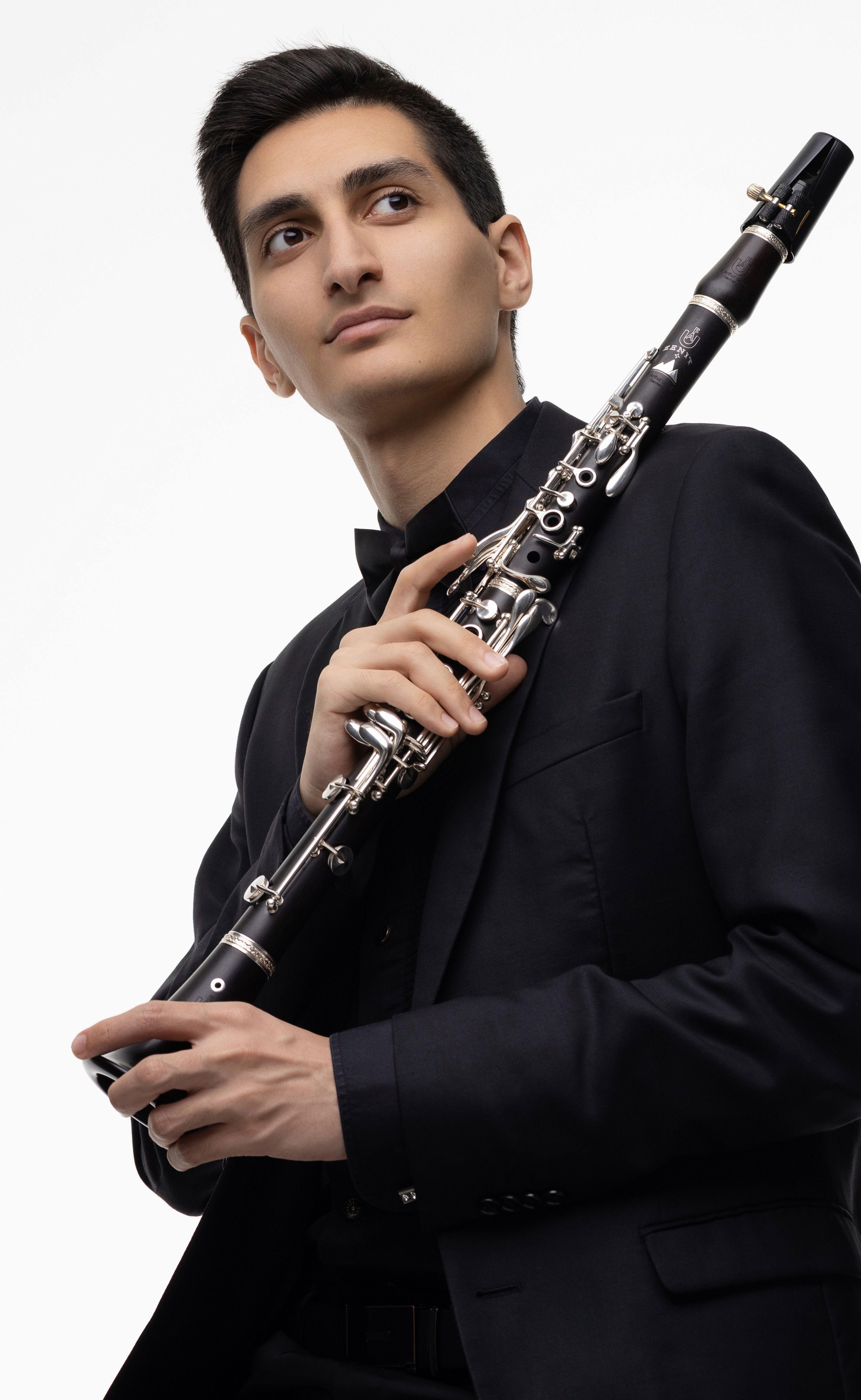
Across solo, chamber, orchestral and festival contexts, Erik has appeared in programmes alongside Daniel Barenboim, Gianandrea Noseda, Joshua Bell, Emmanuel Pahud, Mischa Maisky, Nikolai Lugansky, Alexandre Kantorow, Kian Soltani, Clara-Jumi Kang, Marc Bouchkov, Pablo Ferrández, François Leleux, Aida Garifullina, Ildar Abdrazakov, Michael Barenboim, Yamen Saadi, Chen Reiss, Charles Castronovo, Denis Matsuev, Vladimir Spivakov, Yuri Bashmet, Elena Bashkirova, Nabil Shehata, Vasily Petrenko, Sergey Smbatyan, Daniel Blendulf, Eliso Virsaladze and Alla Sigalova.
His performances have taken place at the Historic Stage of the Bolshoi Theatre, the Great Hall of the Moscow Conservatory, Tchaikovsky Concert Hall, Brucknerhaus Linz, the German Bundestag, Staatsoper Unter den Linden, Pierre Boulez Saal, the National Forum of Music in Wrocław, Fondation Louis Vuitton in Paris, Teatro Filarmonico in Verona, Aram Khachaturian Concert Hall in Yerevan, the Conservatorio di Musica Giuseppe Verdi in Milan, Auditorio de Galicia, Robert Schumann Saal in Düsseldorf, Teatro Marrucino in Chieti, Teatro Fernán Gómez in Madrid, Teatro Principal and Santiago de Compostela Cathedral, Konzerthaus Blaibach, the Hanoi Palace of Culture and Friendship, Shanghai Children’s Art Theatre, the Festsaal of the Vienna Stock Exchange, Etihad Museum, The Theatre at Mall of the Emirates and the conservatoires of Ljubljana and Maribor, the Grand Serail in Beirut, State Kremlin Palace, Zaryadye Concert Hall and the Moscow International House of Music, among others.
His performances have taken him to Germany, Austria, Switzerland, France, Italy, Spain, Denmark, Armenia, Georgia, Russia, Lebanon, the United Arab Emirates, China, Vietnam, Poland, Slovenia, Serbia, Belarus and Ukraine. His concert activity also includes regular appearances at international festivals, government-level cultural events, international summits and concerts hosted by embassies, alongside a longstanding commitment to benefit concerts and charitable initiatives supporting children and adults with disabilities and serious illnesses.
“I position myself first and foremost as a musician.”
Erik Mirzoyan
ClassicalMusicNews · 2025
Erik was born in Moscow on 18 October 2002 into an Armenian family in which no one before him had become a professional musician. The breadth of the career that followed began with a surprisingly simple accident: a visit to a music school that had not been intended for him. His parents had taken his older brother Karen there, hoping that music lessons might form part of his broader education. With no one available to look after four-year-old Erik, they brought him along. Curious about the tests of hearing and rhythm taking place around him, he asked to join in.
The result was unexpected: it was Erik, rather than his brother, who was invited to continue. The Blazhevich Music School normally admitted children from the age of six, and at four he was considered too young for the discipline and pace of structured study. The concern was not his musical aptitude, but whether a child of his age was ready for the demands of the programme. The school nevertheless made an exception, allowing him to join a class and experience those demands for himself. He adapted and became its youngest pupil. Karen, meanwhile, would later enter an entirely different arena as a professional boxer.
When the time came to choose his principal instrument, Erik hoped to study the piano. However, the school specialised in wind instruments, so piano could not become his principal study. He entered the flute class instead, beginning on recorder with Anna Pryalkina. Between the ages of four and six, Erik was already appearing in concerts and receiving awards at numerous competitions for young musicians on the recorder. Piano was nevertheless included in his general musical education as a secondary instrument, alongside ear training, rhythm and music theory.
What began as an unplanned family visit had therefore brought Erik into public performance and competition before the clarinet entered his life. The clarinet would later move to the centre of his musical world. The piano never disappeared, while the Armenian traditions preserved by his family would find a musical voice of their own much later.
At seven, Erik entered the Central Music School of the Moscow Conservatory as a clarinet student. He studied first with Vladimir Ferapontov, a soloist of the Bolshoi Theatre Orchestra. Following Ferapontov’s passing, Erik continued his clarinet studies in the class of Evgeny Petrov, first at the Central Music School and later at the Moscow Conservatory. The school immersed him in a professional musical environment while he was still a child.
In 2012, at ten, Erik entered the thirteenth edition of The Nutcracker, a three-round international television competition for young classical musicians, broadcast throughout and culminating in a live orchestral final. It was his first competition of such a scale and his first major one on the clarinet.
Having advanced through the two preliminary rounds, he reached the final at the Tchaikovsky Concert Hall, a legendary stage of the Moscow Philharmonic. There, before a live television audience, Erik made his first public appearance with a symphony orchestra, performing Sergei Taneyev’s Canzona with the New Russia State Symphony Orchestra under Jan Latham-Koenig. He received first prize, the Golden Nutcracker and the Grand Prix. Within a single competition, he had made his national television debut, performed with a symphony orchestra for the first time and secured his first major victory.
One year later, Erik returned to the same hall for the opening of the competition’s next edition, now appearing as the previous year’s winner.
“An audience can always sense when you are simply playing notes rather than speaking to them through music.”
Erik Mirzoyan
Eurasia Today · 2025
The effect of The Nutcracker was immediate. Within months, Erik’s concert life had expanded beyond Russia and begun to acquire an international rhythm. The first destination was Yerevan, where in March 2013 he appeared with the State Orchestra of Armenia under Sergey Smbatyan at the Aram Khachaturian Concert Hall. Yerevan also marked the beginning of his lasting association with New Names of Armenia. Covering its festival, the Armenian press singled out the eleven-year-old clarinetist, noting the boldness and virtuosity of his playing and the impression he left on the audience. Before the year was over, performances had also taken him to Vienna, Paris, Copenhagen, Teatro Fernán Gómez in Madrid and Teatro Filarmonico in Verona.
The following years brought further orchestral appearances and tours, among them performances in the Great Hall of the Moscow Conservatory with the Moscow State Symphony Orchestra for Children and Youth, and programmes with the Moscow Virtuosi at Philharmonia-2 and Svetlanov Hall and on tour across Russia and Belarus. In 2015, Erik also appeared with the State Symphony Orchestra of the Udmurt Republic, while other engagements took him to Shanghai Children’s Art Theatre in China and, in Vietnam, to Hanoi’s Palace of Culture and Friendship and Lam Son Theatre in Thanh Hoa.
Television continued alongside the concert stage. Erik became a finalist in the first season of Blue Bird and later appeared in the project’s programmes alongside Denis Matsuev and Yuri Bashmet. In 2016, a very different television format brought him together with choreographer Alla Sigalova in Dancing with the Stars.
Paris and Spain, both part of Erik’s first international year, soon became recurring chapters of his concert life. In 2016, he returned to Paris for performances at Fondation Louis Vuitton and to Spain through Peregrinos Musicales, with concerts in Madrid and, in Santiago de Compostela, at Teatro Principal and the city’s Cathedral. His next Peregrinos Musicales season came in 2019, with performances in Sanxenxo and Nigrán before an appearance at the Auditorio de Galicia with the Real Filharmonía de Galicia under Maximino Zumalave.

In March 2017, Erik returned to the Great Hall of the Moscow Conservatory for his first full concert there as the sole featured soloist, appearing with a Symphony Orchestra of Conservatory students.
From the following season, Junior Music Tour brought a new kind of continuity to his concert life. The multi-season project brought laureates of major international and televised competitions into music and arts schools for concerts and creative meetings with young audiences, with its first seasons culminating in large-scale orchestral galas. The first two seasons alone comprised 53 concerts and reached more than 22,000 listeners. Erik appeared repeatedly throughout the series, initially across Moscow and later as the tour expanded into philharmonic halls in other cities.
During these years, the concert hall became only one of several settings for Erik’s work. At Helikon Opera, repeated appearances in Johann Strauss II’s Die Fledermaus placed his clarinet playing within a fully staged theatrical production. He also opened the theatre’s #PRODIGY.kids series and returned for several later programmes. His orchestral work continued in parallel through appearances with the Ryazan Symphony Orchestra, the New Music Symphony Orchestra and, at the Great Hall of Zaryadye, the New Russia State Symphony Orchestra. The scale changed again with Alina 2018, a nationally televised arena festival combining rhythmic gymnastics, choreography and live music. Erik took part in the production at Moscow’s CSKA Arena, configured for audiences of up to 14,000.
At the same time, Erik’s European engagements were becoming both wider and more continuous. Beginning with performances at St Stanislav’s Institution in Ljubljana and Union Hall at Narodni dom Maribor, the route continued through Baden and Zurich, the Conservatorio di Musica Giuseppe Verdi in Milan, Robert Schumann Saal in Düsseldorf and stages in Berlin and Munich. Invitations increasingly extended beyond conventional concert programmes into official, diplomatic and charitable settings, including appearances in Serbia, at an ASEAN summit in Sochi and within the White Flower charity series. Recognition accompanied this expansion: Erik’s name was included in the International Encyclopedia of Culture, Art and Media Figures of Armenia for his contribution to classical music, and he received the Clarinet Special Guest Award at the American Fine Arts Concerto Competition. By September 2019, another German tour brought nine concerts in seven days across Gütersloh, Bielefeld, Harsewinkel, Verl, Greffen and Detmold.
“I want people not simply to listen to music, but to live it with me.”
Erik Mirzoyan
Eurasia Today · 2025
In the same year, Erik also became a laureate of the Constellation competition at Sirius in Sochi. This began a continuing association with its concert programmes, including appearances at the opening of the Sochi Planetarium, the closing of the Big Challenges summit, Sirius.Gala at the St Petersburg International Cultural Forum and the International Volunteer Forum.
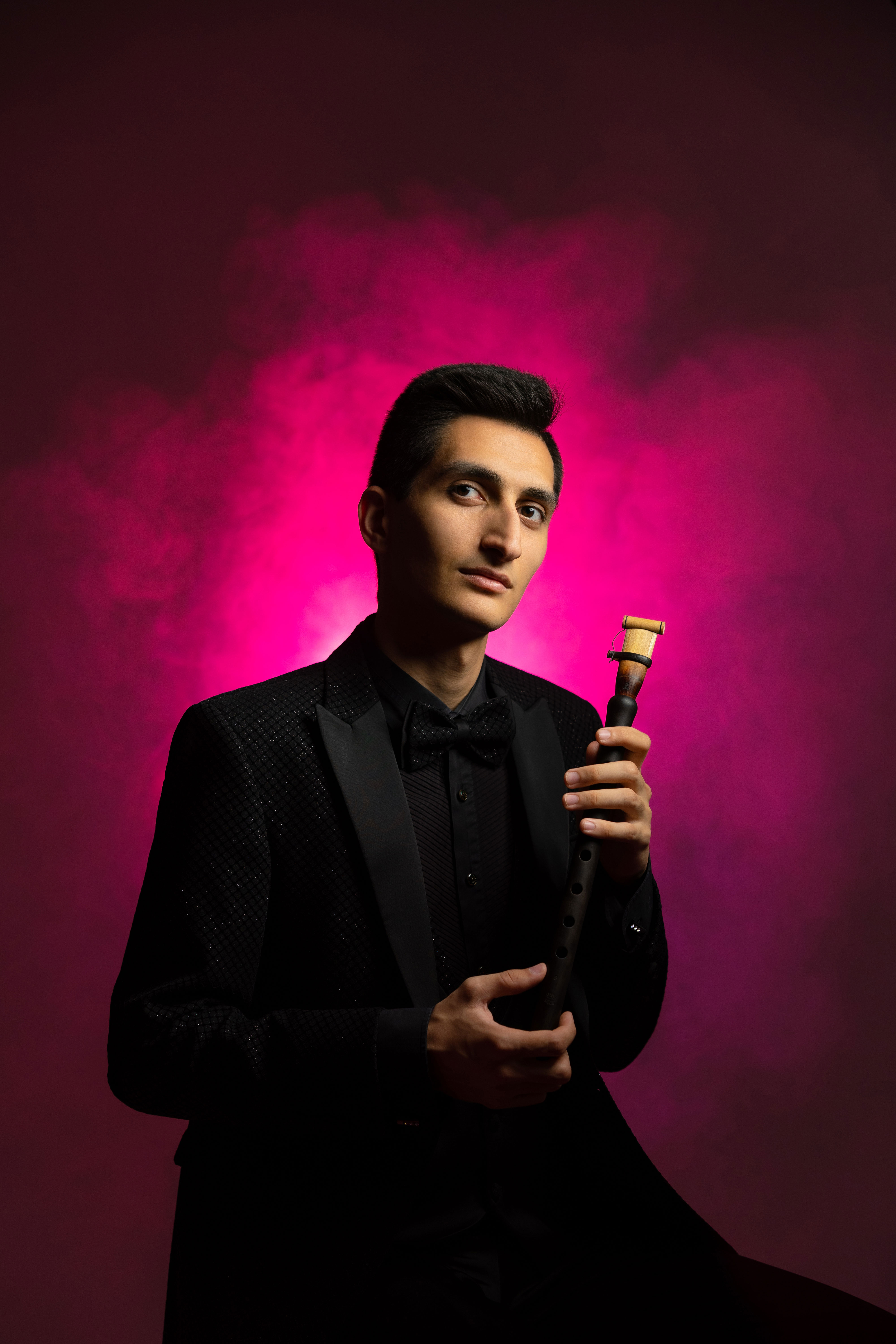
In 2019, the Armenian traditions that had accompanied Erik since childhood found their own instrument in the duduk. He had wanted to play it for years, and a programme established by the Armenian Assembly, with the support of Jivan Gasparyan, gave him the opportunity to begin studying with Armen Hovhannisyan.
The first melody Erik played on the duduk was Dle Yaman, a traditional Armenian melody that would remain closely tied to his relationship with the instrument. In January 2020, only months after beginning his studies, he performed it for Jivan Gasparyan during a masterclass. Gasparyan subsequently signed the duduk Erik had played, and the instrument soon began to enter his public performances.
When Erik created his seven-track duduk album Reflections in 2025, he returned to Dle Yaman and chose it as the opening track. The album therefore begins where his own path with the duduk began: with the same melody he had performed for Gasparyan five years earlier.
In December 2020, Erik released Hungarian Fantasy No. 1, his first clarinet single. The recording debuted at number one on the iTunes Classical Top 200.
In spring 2021, Erik undertook the two-month concert tour Young Stars of Classical Music. The itinerary opened at the Nizhny Novgorod Opera and Ballet Theatre and continued through the Salikh Saydashev State Great Concert Hall in Kazan, Ufa, Krasnoyarsk, the Arnold Katz Concert Hall in Novosibirsk, the Omsk Concert Hall and the Volgograd Philharmonic. It concluded at Moscow’s Great Hall of Zaryadye, where Erik appeared with the Svetlanov State Symphony Orchestra. The final gala was later broadcast by Radio Orpheus.
Later that year, Erik completed the Central Music School with distinction and entered the Moscow State Tchaikovsky Conservatory, continuing his clarinet studies with Evgeny Petrov and secondary piano with Tatiana Tarasevich-Nikolaeva. From his first year, he began working as guest principal clarinet with the Conservatory’s Concert Symphony Orchestra. The role encompassed a wide range of symphonic projects, programmes built around instrumental soloists and large-scale choral works. His own solo and chamber schedule continued alongside it across leading concert stages throughout Russia, with these appearances forming part of the sustained professional rhythm that had accompanied his education for many years.
Beyond the stage, 2021 also opened a more private creative direction. Erik began composing film music and developing original instrumental productions across pop, folk and world music, gaining experience in composition, arranging and music production. Most of this material remains unreleased, but these early experiments would later become increasingly visible in recording projects of his own.
The piano, present alongside Erik’s clarinet studies since childhood, brought him his first competition victory on the instrument in 2022. He received first prize in the Piano Solo category of the Second International Piano Competition for Students of Other Specialisms at the Moscow Conservatory.
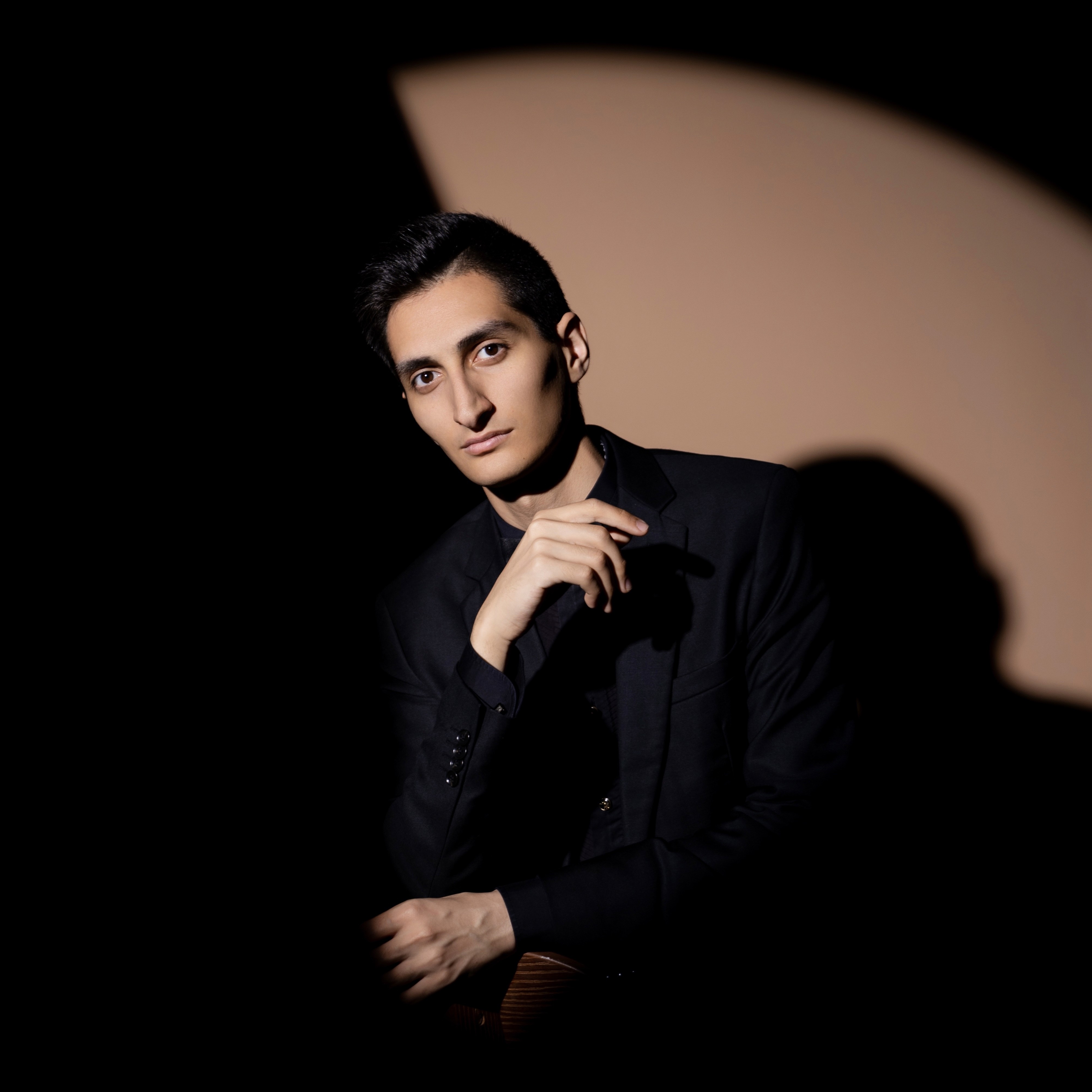
In October 2022, Berlin opened a major new chapter in Erik’s musical formation. He entered the Bachelor of Music programme at the Barenboim–Said Akademie, joining the clarinet class of Matthias Glander and studying chamber music with Emmanuel Pahud. He also continued his secondary piano studies in Berlin with Zinaida Weissmann, extending the training he had received in Moscow. Before the end of that year, he had made his debut at Pierre Boulez Saal.
An active schedule of solo, chamber and orchestral performances continued alongside his studies. At the Akademie, Erik appeared with its orchestra under Daniel Barenboim, while regular individual masterclasses with the maestro established a direct musical exchange that continued throughout his subsequent years at the institution.
Erik’s musical connection with Emmanuel Pahud also extended beyond the chamber-music class. In May 2023, he performed alongside Emmanuel Pahud for the first time in a chamber programme at Pierre Boulez Saal, beginning a series of shared projects that would continue across later seasons. Berlin brought with it a contrasting approach to ensemble playing, rehearsal and interpretation.
“Moscow is depth, academic tradition – my foundation. Berlin offers a different approach: freedom, openness and a dialogue of cultures.”
Erik Mirzoyan
Eurasia Today · 2025
During his first academic year in Berlin, Erik also returned to the international competition circuit. At Classic Winds in Dubai, a four-round international competition for wind players, he progressed to the final. The competition took place at the Etihad Museum and The Theatre at Mall of Emirates, culminating in an orchestral round in which Erik performed with the Armenian State Symphony Orchestra under Sergey Smbatyan – almost exactly ten years after their first concert together in Yerevan.
Later in 2023, he became a laureate of the Chieti Classica International Clarinet Competition in Italy. In the orchestral final at Teatro Marrucino, Erik performed with the Kyiv Virtuosi Orchestra under Dmitry Yablonsky.
By 2024, Erik’s orchestral schedule was extending through a new sequence of European engagements. As an invited clarinetist, he joined the Akademieorchester of the Staatskapelle Berlin for a concert in the Main Hall of the Witold Lutosławski National Forum of Music in Wrocław. He then joined Eroica Berlin for concerts marking the 150th anniversary of Charles Ives, appearing at Konzerthaus Blaibach and in the Great Hall of the Brucknerhaus in Linz. The project was broadcast by Bavarian Radio.
The piano, however, had never disappeared. On 12 July 2024, Erik released Solitude, his first solo piano album. Across eleven tracks and more than an hour of music, the recording brought together works by Johannes Brahms, Ludwig van Beethoven, Sergei Rachmaninoff, Pyotr Ilyich Tchaikovsky, Nikolai Medtner, Frédéric Chopin and Jean Sibelius. It gave the instrument an independent place within his public work, extending a relationship that had begun as his earliest childhood ambition. Solitude was subsequently included in the GRAMMY Awards longlist for Best Classical Instrumental Solo.
Later that summer, Erik joined the Pan-Caucasian Youth Orchestra for the 2024 Tsinandali Festival in Georgia. He appeared in orchestral programmes led by Gianandrea Noseda, Vasily Petrenko and François Leleux, with Joshua Bell, Alexandre Kantorow and Chen Reiss among the season’s artists.
Alongside his orchestral work, Erik initiated a performance of Mozart’s Clarinet Quintet, forming a string quartet from within the orchestra with musicians from different national and cultural backgrounds. The performance took place on 3 September. Billboard magazine later featured the project in its international coverage of Tsinandali, presenting it within a wider account of music as a space for dialogue across political and historical divisions.

That autumn, Erik returned to Italy for the twentieth edition of the Saverio Mercadante International Clarinet Competition in Noci, where he became a laureate in the Senior Soloists category.
In March 2025, Erik appeared at Momentum Festival at Kühlhaus Berlin, performing Bartók’s Contrasts with Elena Bashkirova. During the same programme, he also performed two pieces from Reflections, then his forthcoming duduk album, bringing material from the recording into a live setting several months before its release.
In July, Erik returned to a theatrical setting, joining the Bühnenmusik ensemble for a performance of Verdi’s La Traviata at Staatsoper Unter den Linden.
That summer, as Reflections approached release, Erik’s article The Sound That Echoes Through Generations was published by the Barenboim–Said Akademie. The article explored how a sound rooted in one culture can carry memory beyond national borders.
“There are sounds that feel like they have always existed.”
Erik Mirzoyan
The Sound That Echoes Through Generations · 2025
On 22 August 2025, two albums featuring Erik’s work with the duduk were released on the same day: Reflections, his own seven-track recording, and Samsara Passengers, created by Øneheart, Dean Korso and leadwave.
Reflections centres on memory, inheritance and the emotional world of the Armenian duduk. It opens with Dle Yaman, the first melody Erik had played on the instrument and the same work he had performed for Jivan Gasparyan five years earlier. Erik approached the album’s traditional material not only as a performer, but also as an arranger and producer, creating his own arrangements and shaping the production of Tsaghkats Baleni and Sareri Hovin Mernem. Reflections was subsequently included in the GRAMMY Awards longlists for Best Global Music Album and Best Folk Album.
Samsara Passengers placed the duduk within a markedly different contemporary ambient language. Erik composed and performed the central duduk melody of its opening track, Shifting Sands, and also performed on Nomad. Released alongside the traditional sound world of Reflections, the collaboration brought his work as a composer and instrumentalist into an electronic setting.
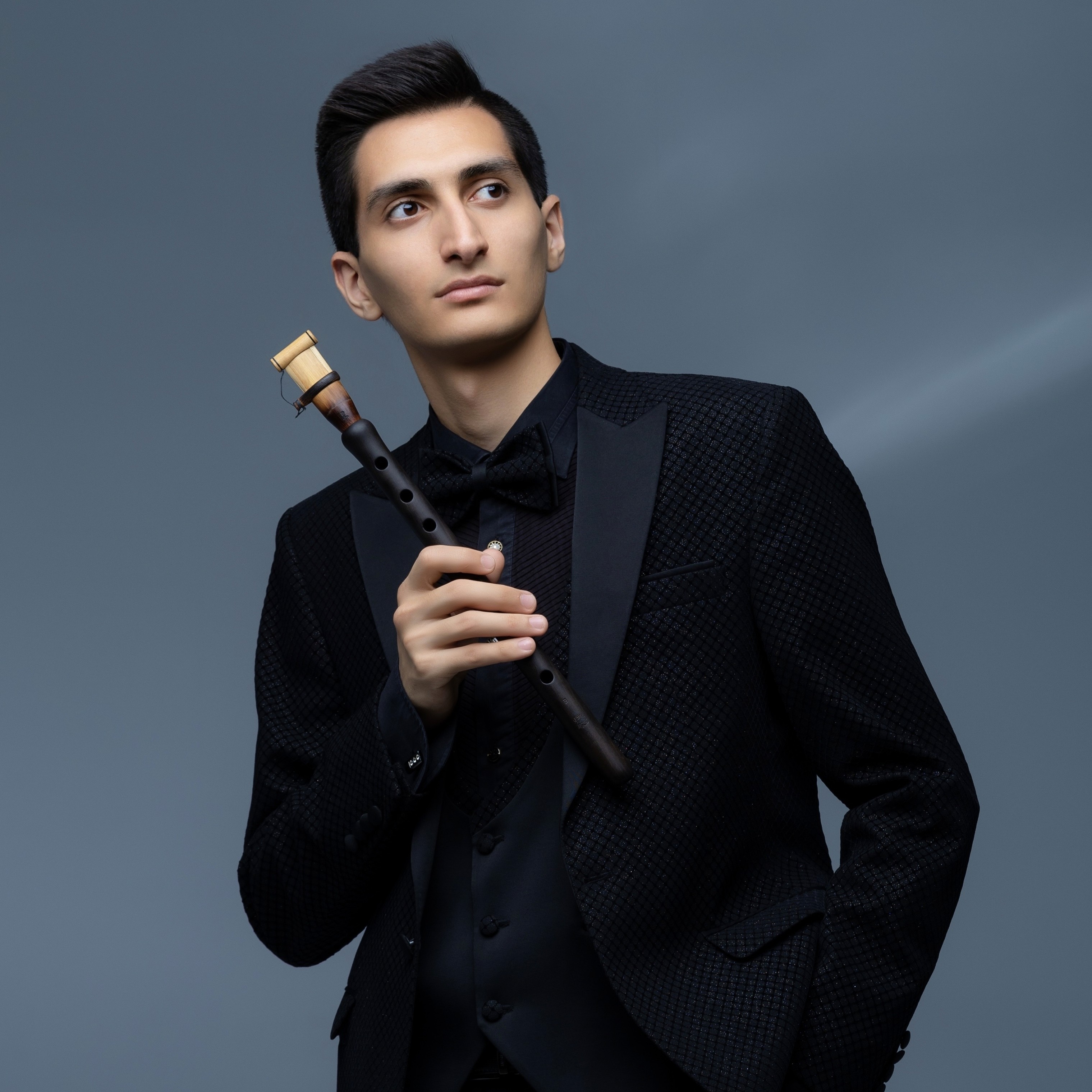
Later that season, Erik returned to the Tsinandali Festival and the Pan-Caucasian Youth Orchestra for a second consecutive year. He appeared in programmes led by Gianandrea Noseda and Daniel Blendulf, within a festival season involving Marc Bouchkov, Mischa Maisky, Nikolai Lugansky and Pablo Ferrández. Continuing the sequence of clarinet quintets he had begun at Tsinandali the previous year, Erik performed Brahms’s Clarinet Quintet and also presented music from Reflections on duduk.
In October, Erik presented Reflections in concert at the All-Russian Cello Academy, opening its new season with the Academy’s founder, Anastasia Ushakova. His wider performing schedule included orchestral and chamber programmes at Pierre Boulez Saal under Daniel Barenboim and Nabil Shehata, including concert with Clara-Jumi Kang as soloist. The performance also marked Erik’s debut on the German-system clarinet and reflected his decision to honour German repertoire through the German clarinet tradition. The German and French systems differ substantially in construction, fingering, sound and playing approach. Professional command of both is rare and has become a distinctive aspect of Erik’s work as a clarinetist.
His orchestral work also extended to Russian National Orchestra and Beirut through a project-based collaboration with the Lebanese National Philharmonic Orchestra, which invited him as guest principal clarinet across multiple engagements. These included concerts at the Grand Serail, the Armenian Orthodox Church and other venues across the city, as well as studio recording work with the orchestra.
In December, a programme at Kühlhaus Berlin with Taiseer Elias featured Erik on both clarinet and duduk.
Teaching entered this period as a further part of his professional activity. In March 2026, Erik led a four-hour clarinet masterclass for the New School project, whose programme presents active concert musicians as a new generation of teachers. Later that month, his work with the All-Russian Cello Academy continued at the closing gala of its fourth edition in the Great Hall of the Moscow Conservatory, where he performed on duduk alongside Anastasia Ushakova in the world premiere of Murat Kabardokov’s Elegy for duduk, cello and orchestra.
“Music is not a museum piece. It must evolve while remaining free within tradition.”
Erik Mirzoyan
ClassicalMusicNews · 2025
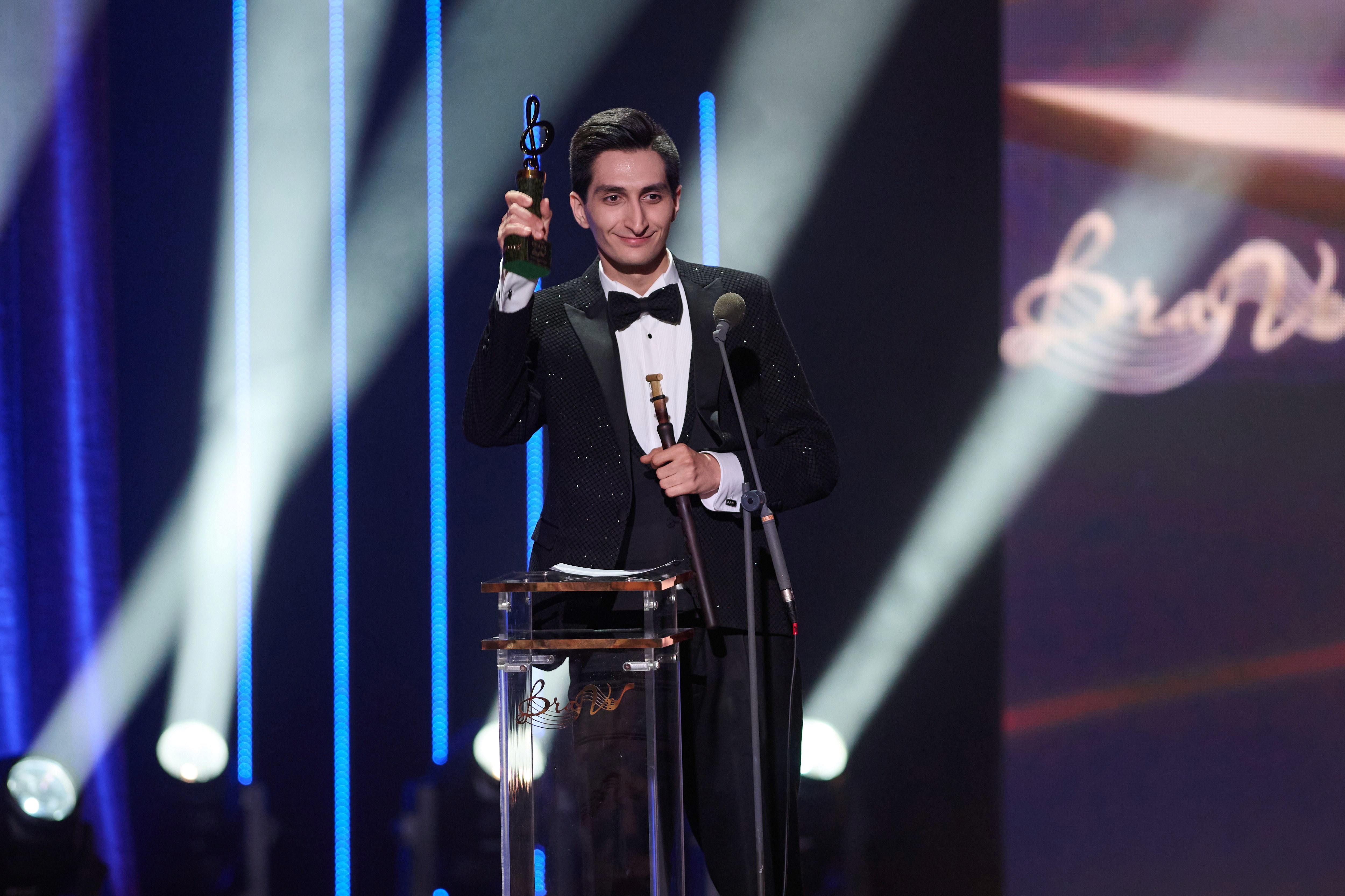
In April 2026, Reflections received the BraVo Award for Classical Album of the Year. At the ceremony on the Historic Stage of the Bolshoi Theatre, Erik performed Hans Zimmer’s Now We Are Free from the film Gladiator.
Later in April, Erik returned to Pierre Boulez Saal for a chamber programme with Emmanuel Pahud, continuing the musical tradition first established there in 2023. In May, he performed on duduk at an international KazanForum gala at the Galiasgar Kamal Theatre, appearing with the Kamal Theatre Orchestra. Later that month, Erik returned to Pierre Boulez Saal for an all-Schumann orchestral programme under Nabil Shehata, with Kian Soltani as soloist in the Cello Concerto. He again performed throughout on the German-system clarinet.
Erik’s work also entered prominent institutional and interdisciplinary settings beyond the conventional concert hall, with appearances at Filmempfang 2026 in the German Bundestag and the Better World Summit at Google Center Berlin.
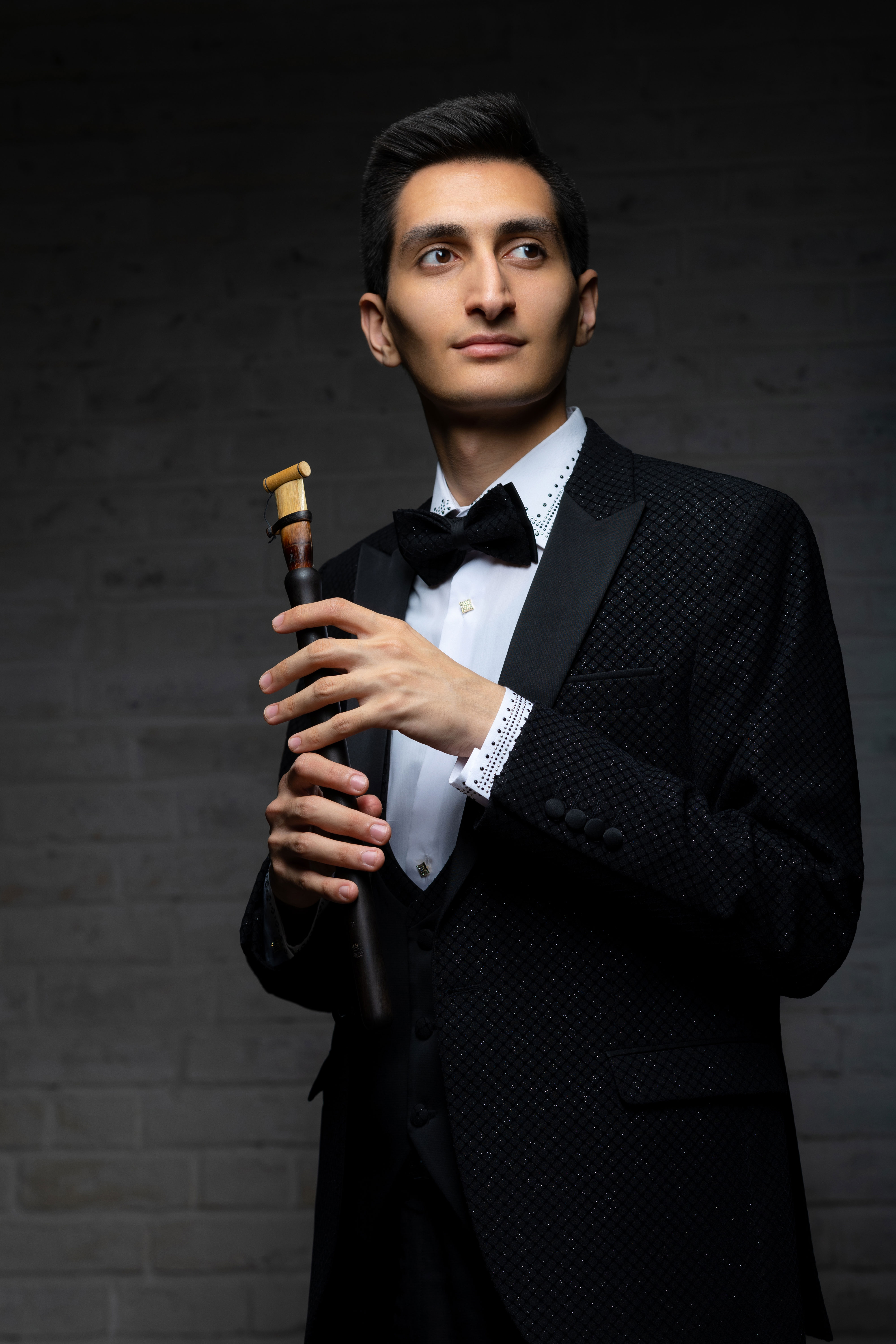
On 18 June 2026, Erik gave A Journey Through Sound, his Bachelor of Music graduation recital, at Pierre Boulez Saal. Conceived entirely by Erik, it was designed not as a conventional clarinet recital, but as a complete portrait of the musical identity he had developed throughout his life. Over the course of one evening, he performed on French-system and German-system clarinets, Armenian duduk and piano, moving between instruments, genres and performance traditions within a single programme.
The use of both clarinet systems in one recital was itself highly unusual. Rather than presenting their differences as a technical display, Erik chose each system for the repertoire, sound world and instrumental tradition it could best serve. The wider conception followed the same principle: the clarinet remained the structural centre of the recital, while piano and duduk opened expressive worlds that required entirely different voices.
The concert marked both the culmination of his Bachelor studies and the first complete realisation of a format he had long envisioned – one artist moving between three instruments and two clarinet systems without reducing them to a single style. Each retained its own history, technique and expressive purpose. A Journey Through Sound brought the separate musical paths of Erik’s life onto one stage for the first time, giving concert form to the artistic identity he had been building since childhood.
“Each instrument reveals a new side of me and helps me tell a different part of my story.”
Erik Mirzoyan
ClassicalMusicNews · 2025
In 2026, two major stages of Erik’s formal training reached completion: the Bachelor of Music at the Barenboim–Said Akademie and, with distinction, the Specialist programme at the Moscow State Tchaikovsky Conservatory. From autumn 2026, he continues his education through the Master of Music programme at the Barenboim–Said Akademie and the Assistantship–Internship programme at the Moscow Conservatory.
At twenty-three, Erik stands at the point where a long period of formation begins to turn decisively into authorship. The clarinet remains at the centre of his musical life, while duduk and piano open entirely different expressive histories around it. Between Moscow and Berlin, concert stage and studio, inherited repertoire and projects of his own, the next chapter is increasingly defined not by the number of musical worlds he inhabits, but by what he chooses to create within them.
VIEW LIVE →