BACK TO PRESS →
EURASIA TODAY
Erik Mirzoyan: “The Duduk Is a Voice That Comes from the Depths of Time ”
6 October 2025 · Interview
By Yulia Rozhdestvenskaya
BACK TO PRESS →
EURASIA TODAY
Erik Mirzoyan: “The Duduk Is a Voice That Comes from the Depths of Time ”
6 October 2025 · Interview
By Yulia Rozhdestvenskaya
BACK TO PRESS →
EURASIA TODAY
Erik Mirzoyan: “The Duduk Is a Voice That Comes from the Depths of Time ”
6 October 2025 · Interview
By Yulia Rozhdestvenskaya
Erik Mirzoyan on the particularities of playing the duduk and clarinet, fulfilling a childhood dream, the differences between the Russian and European schools of music, and recording his new album.
Erik Mirzoyan on the particularities of playing the duduk and clarinet, fulfilling a childhood dream, the differences between the Russian and European schools of music, and recording his new album.
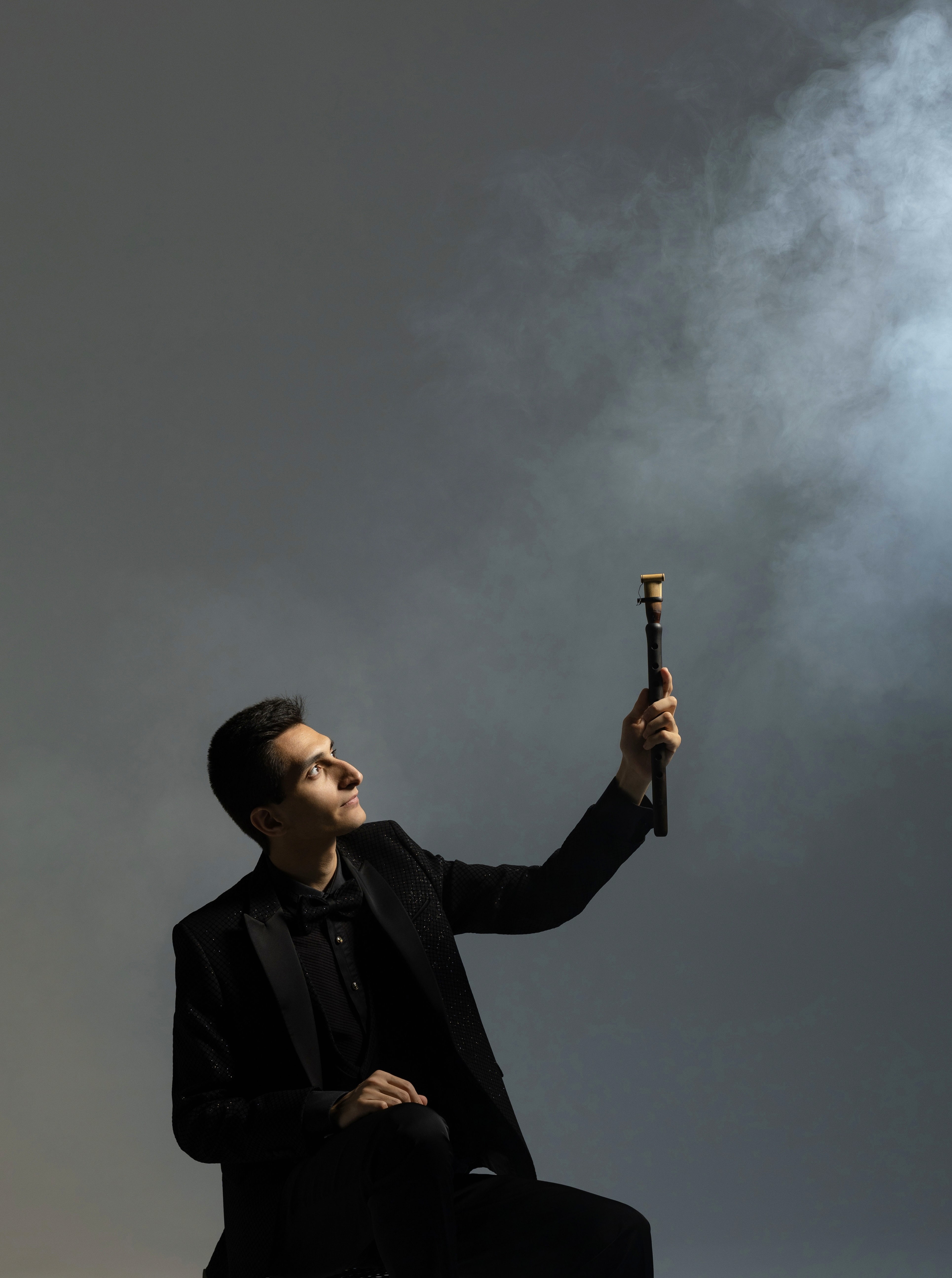
— On 5 October, your solo album Reflections, devoted to the Armenian folk instrument the duduk, was presented at the Chamber Hall of the All-Russian Cello Academy in Moscow. The work has already received recognition: it was longlisted for the Grammy Awards in two categories, Best Global Music Album and Best Folk Album. You have described the album as “a space for reflection on memory, heritage, and emotion.” How did this idea arise? Was the concept planned in advance, or did the music itself lead you to it?
— I would say that it all began with a feeling rather than a concept. Of course, the duduk had always been an instrument I dreamed of playing, but it was the music itself that led me to this idea. When I first held the instrument, I became completely convinced that it was not just an instrument. For that, I am especially grateful to my wonderful teacher and duduk master Armen Hovhannisyan, who patiently and sensitively taught me from the very beginning to feel and understand the nature of the instrument in the most authentic traditions of Armenian music. The voice of the duduk seems to come from the depths of time, and there is something in that voice that cannot be ignored. It carries not only personal emotion but also collective memory. Gradually, I understood that this was precisely the space for reflection: on what we carry within us, what we remember, and what does not disappear even across generations.
The Armenian duduk is an extraordinary phenomenon. It does not cry out its pain; rather, it carries that pain within. This hidden yet incredibly powerful energy is what makes it special. On the one hand, it is a national instrument and part of the Armenian heritage. On the other, its timbre can touch anyone, even someone hearing it for the first time who knows nothing of its history. This matters greatly to me: music born within one particular culture can reach beyond it and speak a universal language.
That is how the idea for Reflections emerged. It is not an album in the conventional sense, but rather a space in which memory, heritage, and emotion come together. I felt not so much like a composer as a conduit: the music truly led me and showed me what each step should be.
— With that in mind, how did you shape the track list? Is it a story with a plot and a sense of development, or more a collection of separate yet interconnected meditations?
— For me, it is more a series of meditations, although they are connected by an inner logic. Each track is like an individual thought, but together they form a particular path. Of course, I think the album can be heard selectively, but if you take it in from beginning to end, it becomes a kind of meditative journey.
That journey recalls the history of the Armenian people and, more broadly, the history of memory itself. There are tracks in which one feels grief and mourning, as in Dle Yaman. This melody arose from the collective trauma of the Armenian genocide, when an entire people were driven from their homeland and millions died. Yet the music contains not only tragedy but also extraordinary strength: the ability to survive, to preserve a culture, a language, and a faith.
There are also pieces in which light appears, where you sense that hope comes after grief. I wanted the album to speak not only about pain but also about resilience—about memory being not only a burden, but also a light passed on to others.
So yes, the track list is not a linear narrative, but rather a journey through different states. That is precisely where its unity lies.
— You are a virtuoso on the clarinet and piano, instruments with immense classical repertoires. Why did you choose the duduk for such a personal, conceptual statement? What can it say that other instruments cannot? Why do you think it is called “the voice of the soul”?
— I love the clarinet and piano very much, and they remain my most important instruments. But when I wanted to say something truly personal, I realized that the duduk was the instrument capable of expressing it. It is called “the voice of the soul,” and that really is true. Its timbre is not simply a sound; it is a voice that can weep, share pain, and also heal.
For me, the clarinet and piano are instruments with an immense academic tradition. They allow me to say many things the duduk cannot. But the duduk, in turn, says what they are unable to say. There is something archaic and ancient within it, something that does not depend on the listener’s cultural background. You may not know a word of Armenian and may never have heard anything about Armenian history, yet when the duduk sounds, it touches something profoundly human within you.
I think this is connected to the phenomenon of cultural memory. Every nation carries its own sounds, melodies, tastes, and scents. But certain timbres reach beyond a single culture. The duduk is one of them. It reminds us that we are not merely separate individuals, but part of a vast human history with all its losses, joys, and hopes.
— This album is about memory and heritage. While recording or rehearsing, did you feel that you were in dialogue with, or connected to, your Armenian roots? Could you share the story—perhaps a family story—behind one of the album’s most personal tracks?
— Yes, of course; that feeling was present throughout. Every time I played, I felt that not only my own self was speaking through me, but also the voices that had sounded before me. I felt this especially strongly in Dle Yaman. This music is truly special to me. It was the first melody I played on the duduk. In 2019, I was fortunate enough to perform it for the legendary Jivan Gasparyan at a masterclass. It has remained my most personal piece ever since, which is why I decided to open the album with it. It is, in a sense, the starting point of the entire journey.
— On 5 October, your solo album Reflections, devoted to the Armenian folk instrument the duduk, was presented at the Chamber Hall of the All-Russian Cello Academy in Moscow. The work has already received recognition: it was longlisted for the Grammy Awards in two categories, Best Global Music Album and Best Folk Album. You have described the album as “a space for reflection on memory, heritage, and emotion.” How did this idea arise? Was the concept planned in advance, or did the music itself lead you to it?
— I would say that it all began with a feeling rather than a concept. Of course, the duduk had always been an instrument I dreamed of playing, but it was the music itself that led me to this idea. When I first held the instrument, I became completely convinced that it was not just an instrument. For that, I am especially grateful to my wonderful teacher and duduk master Armen Hovhannisyan, who patiently and sensitively taught me from the very beginning to feel and understand the nature of the instrument in the most authentic traditions of Armenian music. The voice of the duduk seems to come from the depths of time, and there is something in that voice that cannot be ignored. It carries not only personal emotion but also collective memory. Gradually, I understood that this was precisely the space for reflection: on what we carry within us, what we remember, and what does not disappear even across generations.
The Armenian duduk is an extraordinary phenomenon. It does not cry out its pain; rather, it carries that pain within. This hidden yet incredibly powerful energy is what makes it special. On the one hand, it is a national instrument and part of the Armenian heritage. On the other, its timbre can touch anyone, even someone hearing it for the first time who knows nothing of its history. This matters greatly to me: music born within one particular culture can reach beyond it and speak a universal language.
That is how the idea for Reflections emerged. It is not an album in the conventional sense, but rather a space in which memory, heritage, and emotion come together. I felt not so much like a composer as a conduit: the music truly led me and showed me what each step should be.
— With that in mind, how did you shape the track list? Is it a story with a plot and a sense of development, or more a collection of separate yet interconnected meditations?
— For me, it is more a series of meditations, although they are connected by an inner logic. Each track is like an individual thought, but together they form a particular path. Of course, I think the album can be heard selectively, but if you take it in from beginning to end, it becomes a kind of meditative journey.
That journey recalls the history of the Armenian people and, more broadly, the history of memory itself. There are tracks in which one feels grief and mourning, as in Dle Yaman. This melody arose from the collective trauma of the Armenian genocide, when an entire people were driven from their homeland and millions died. Yet the music contains not only tragedy but also extraordinary strength: the ability to survive, to preserve a culture, a language, and a faith.
There are also pieces in which light appears, where you sense that hope comes after grief. I wanted the album to speak not only about pain but also about resilience—about memory being not only a burden, but also a light passed on to others.
So yes, the track list is not a linear narrative, but rather a journey through different states. That is precisely where its unity lies.
— You are a virtuoso on the clarinet and piano, instruments with immense classical repertoires. Why did you choose the duduk for such a personal, conceptual statement? What can it say that other instruments cannot? Why do you think it is called “the voice of the soul”?
— I love the clarinet and piano very much, and they remain my most important instruments. But when I wanted to say something truly personal, I realized that the duduk was the instrument capable of expressing it. It is called “the voice of the soul,” and that really is true. Its timbre is not simply a sound; it is a voice that can weep, share pain, and also heal.
For me, the clarinet and piano are instruments with an immense academic tradition. They allow me to say many things the duduk cannot. But the duduk, in turn, says what they are unable to say. There is something archaic and ancient within it, something that does not depend on the listener’s cultural background. You may not know a word of Armenian and may never have heard anything about Armenian history, yet when the duduk sounds, it touches something profoundly human within you.
I think this is connected to the phenomenon of cultural memory. Every nation carries its own sounds, melodies, tastes, and scents. But certain timbres reach beyond a single culture. The duduk is one of them. It reminds us that we are not merely separate individuals, but part of a vast human history with all its losses, joys, and hopes.
— This album is about memory and heritage. While recording or rehearsing, did you feel that you were in dialogue with, or connected to, your Armenian roots? Could you share the story—perhaps a family story—behind one of the album’s most personal tracks?
— Yes, of course; that feeling was present throughout. Every time I played, I felt that not only my own self was speaking through me, but also the voices that had sounded before me. I felt this especially strongly in Dle Yaman. This music is truly special to me. It was the first melody I played on the duduk. In 2019, I was fortunate enough to perform it for the legendary Jivan Gasparyan at a masterclass. It has remained my most personal piece ever since, which is why I decided to open the album with it. It is, in a sense, the starting point of the entire journey.
— On 5 October, your solo album Reflections, devoted to the Armenian folk instrument the duduk, was presented at the Chamber Hall of the All-Russian Cello Academy in Moscow. The work has already received recognition: it was longlisted for the Grammy Awards in two categories, Best Global Music Album and Best Folk Album. You have described the album as “a space for reflection on memory, heritage, and emotion.” How did this idea arise? Was the concept planned in advance, or did the music itself lead you to it?
— I would say that it all began with a feeling rather than a concept. Of course, the duduk had always been an instrument I dreamed of playing, but it was the music itself that led me to this idea. When I first held the instrument, I became completely convinced that it was not just an instrument. For that, I am especially grateful to my wonderful teacher and duduk master Armen Hovhannisyan, who patiently and sensitively taught me from the very beginning to feel and understand the nature of the instrument in the most authentic traditions of Armenian music. The voice of the duduk seems to come from the depths of time, and there is something in that voice that cannot be ignored. It carries not only personal emotion but also collective memory. Gradually, I understood that this was precisely the space for reflection: on what we carry within us, what we remember, and what does not disappear even across generations.
The Armenian duduk is an extraordinary phenomenon. It does not cry out its pain; rather, it carries that pain within. This hidden yet incredibly powerful energy is what makes it special. On the one hand, it is a national instrument and part of the Armenian heritage. On the other, its timbre can touch anyone, even someone hearing it for the first time who knows nothing of its history. This matters greatly to me: music born within one particular culture can reach beyond it and speak a universal language.
That is how the idea for Reflections emerged. It is not an album in the conventional sense, but rather a space in which memory, heritage, and emotion come together. I felt not so much like a composer as a conduit: the music truly led me and showed me what each step should be.
— With that in mind, how did you shape the track list? Is it a story with a plot and a sense of development, or more a collection of separate yet interconnected meditations?
— For me, it is more a series of meditations, although they are connected by an inner logic. Each track is like an individual thought, but together they form a particular path. Of course, I think the album can be heard selectively, but if you take it in from beginning to end, it becomes a kind of meditative journey.
That journey recalls the history of the Armenian people and, more broadly, the history of memory itself. There are tracks in which one feels grief and mourning, as in Dle Yaman. This melody arose from the collective trauma of the Armenian genocide, when an entire people were driven from their homeland and millions died. Yet the music contains not only tragedy but also extraordinary strength: the ability to survive, to preserve a culture, a language, and a faith.
There are also pieces in which light appears, where you sense that hope comes after grief. I wanted the album to speak not only about pain but also about resilience—about memory being not only a burden, but also a light passed on to others.
So yes, the track list is not a linear narrative, but rather a journey through different states. That is precisely where its unity lies.
— You are a virtuoso on the clarinet and piano, instruments with immense classical repertoires. Why did you choose the duduk for such a personal, conceptual statement? What can it say that other instruments cannot? Why do you think it is called “the voice of the soul”?
— I love the clarinet and piano very much, and they remain my most important instruments. But when I wanted to say something truly personal, I realized that the duduk was the instrument capable of expressing it. It is called “the voice of the soul,” and that really is true. Its timbre is not simply a sound; it is a voice that can weep, share pain, and also heal.
For me, the clarinet and piano are instruments with an immense academic tradition. They allow me to say many things the duduk cannot. But the duduk, in turn, says what they are unable to say. There is something archaic and ancient within it, something that does not depend on the listener’s cultural background. You may not know a word of Armenian and may never have heard anything about Armenian history, yet when the duduk sounds, it touches something profoundly human within you.
I think this is connected to the phenomenon of cultural memory. Every nation carries its own sounds, melodies, tastes, and scents. But certain timbres reach beyond a single culture. The duduk is one of them. It reminds us that we are not merely separate individuals, but part of a vast human history with all its losses, joys, and hopes.
— This album is about memory and heritage. While recording or rehearsing, did you feel that you were in dialogue with, or connected to, your Armenian roots? Could you share the story—perhaps a family story—behind one of the album’s most personal tracks?
— Yes, of course; that feeling was present throughout. Every time I played, I felt that not only my own self was speaking through me, but also the voices that had sounded before me. I felt this especially strongly in Dle Yaman. This music is truly special to me. It was the first melody I played on the duduk. In 2019, I was fortunate enough to perform it for the legendary Jivan Gasparyan at a masterclass. It has remained my most personal piece ever since, which is why I decided to open the album with it. It is, in a sense, the starting point of the entire journey.
— If Reflections were not an album but a landscape, what would it be? The mountains of Armenia, misty streets in Berlin, or perhaps evenings in Moscow?
— To me, this album most resembles the Armenian mountains. Imagine high peaks veiled in mist and ancient stones holding thousands of years of history. There is harshness and tragedy in this landscape, but at the same time there is extraordinary natural beauty and silence. These mountains remember everything: joy and pain, rises and falls. In the same way, the music of the duduk holds the memory of generations.
Seen through the lens of the present, however, I think there is also something of the Berlin streets in this landscape, because that is where I now study and spend much of my life. Berlin in the evening, with its mist and lights, evokes the atmosphere of the album: you may be in a modern city, but the air carries a sense of history, memory, and something from the past. And of course, my beloved city of Moscow is present too, because this is where I grew up, studied, took my first steps in music, and am now presenting this special project. So I would say that Reflections is a landscape in which the Armenian mountains meet European and Moscow streets—a space in which past and present coexist and enter into dialogue.
— Speaking of the concert, why did you choose the Chamber Hall of the Cello Academy to present such a personal album? What matters more in a live performance: conveying perfection of sound, or the intimacy of that “personal journey”?
— For me, this album is first and foremost a personal conversation, and a chamber hall is ideal for that kind of exchange. In a large hall, it is as though you have to speak loudly in order to be heard. Here, you can speak quietly and share something deeply personal, and every listener will still feel it.
When I play the duduk, to be honest, I do not think about perfection of sound in the academic sense. Technique, purity, and quality of sound are important, of course—they are the basic minimum for a professional performer. But it is far more important to convey feeling, sensitivity, and that very vulnerability. For me, this concert, like any other, is an invitation into another reality. I want people not simply to listen to the music, but to live through it with me.
— You are one of the young teachers involved in New School, a project of the All-Russian Cello Academy. Do you feel that participating in such a project is about more than teaching—that together you are laying the foundations for a new musical environment in Russia? And can we expect this work to develop into new formal projects and initiatives in the future?
— Yes, absolutely. For me, the Academy and the New School project are not only about education, but also about creating a special environment in which we can search for new meaning in music. Music is not a museum exhibit. It must live, develop, and find new forms, and for that it needs freedom. Working with young musicians, we are, in a sense, building the future: laying down values that will later live on in their own creative work.
Moreover, young performing musicians also have something to share and something to say, based first and foremost on their personal experience and their experience onstage. Our profession requires us to travel, perform, and exchange experience with many different musicians. And then there are our own teachers, whose direct continuation we are. I am certain that this project has great potential. I like the fact that there are no age restrictions for participants. It gives schoolchildren who are only beginning to find themselves the opportunity to study with someone who faced the same difficulties not so long ago and fully understands and shares their concerns. It also serves older students who are in the final stage of their education. For us as young teachers, it is valuable experience too: a meeting of creative practice and musical communication. It is not about creating distance, but about an open dialogue.
— Your path began with victories in major competitions for young musicians, The Blue Bird and The Nutcracker. Do you think that experience of performing for a large audience as a child helped you present a project as intimate and profound as Reflections today?
— Of course, it helped a great deal. You know, when you walk onto a stage as a child and understand that millions of people are watching you on television, it is a powerful experience. It teaches responsibility, concentration, and the ability to hold an audience’s attention. Most importantly, however, it teaches you to be genuine, because an audience can always tell if you are merely playing the notes rather than speaking to them through music.
Now, when I create projects—large-scale or intimate—I feel that these are two sides of the same experience. There, you have scope, spectacle, and the energy of a great hall. Here, you have fragility, silence, and closeness. But in both settings, the most important thing is to be honest in the music. That is what I learned back then, as a child.
— If Reflections were not an album but a landscape, what would it be? The mountains of Armenia, misty streets in Berlin, or perhaps evenings in Moscow?
— To me, this album most resembles the Armenian mountains. Imagine high peaks veiled in mist and ancient stones holding thousands of years of history. There is harshness and tragedy in this landscape, but at the same time there is extraordinary natural beauty and silence. These mountains remember everything: joy and pain, rises and falls. In the same way, the music of the duduk holds the memory of generations.
Seen through the lens of the present, however, I think there is also something of the Berlin streets in this landscape, because that is where I now study and spend much of my life. Berlin in the evening, with its mist and lights, evokes the atmosphere of the album: you may be in a modern city, but the air carries a sense of history, memory, and something from the past. And of course, my beloved city of Moscow is present too, because this is where I grew up, studied, took my first steps in music, and am now presenting this special project. So I would say that Reflections is a landscape in which the Armenian mountains meet European and Moscow streets—a space in which past and present coexist and enter into dialogue.
— Speaking of the concert, why did you choose the Chamber Hall of the Cello Academy to present such a personal album? What matters more in a live performance: conveying perfection of sound, or the intimacy of that “personal journey”?
— For me, this album is first and foremost a personal conversation, and a chamber hall is ideal for that kind of exchange. In a large hall, it is as though you have to speak loudly in order to be heard. Here, you can speak quietly and share something deeply personal, and every listener will still feel it.
When I play the duduk, to be honest, I do not think about perfection of sound in the academic sense. Technique, purity, and quality of sound are important, of course—they are the basic minimum for a professional performer. But it is far more important to convey feeling, sensitivity, and that very vulnerability. For me, this concert, like any other, is an invitation into another reality. I want people not simply to listen to the music, but to live through it with me.
— You are one of the young teachers involved in New School, a project of the All-Russian Cello Academy. Do you feel that participating in such a project is about more than teaching—that together you are laying the foundations for a new musical environment in Russia? And can we expect this work to develop into new formal projects and initiatives in the future?
— Yes, absolutely. For me, the Academy and the New School project are not only about education, but also about creating a special environment in which we can search for new meaning in music. Music is not a museum exhibit. It must live, develop, and find new forms, and for that it needs freedom. Working with young musicians, we are, in a sense, building the future: laying down values that will later live on in their own creative work.
Moreover, young performing musicians also have something to share and something to say, based first and foremost on their personal experience and their experience onstage. Our profession requires us to travel, perform, and exchange experience with many different musicians. And then there are our own teachers, whose direct continuation we are. I am certain that this project has great potential. I like the fact that there are no age restrictions for participants. It gives schoolchildren who are only beginning to find themselves the opportunity to study with someone who faced the same difficulties not so long ago and fully understands and shares their concerns. It also serves older students who are in the final stage of their education. For us as young teachers, it is valuable experience too: a meeting of creative practice and musical communication. It is not about creating distance, but about an open dialogue.
— Your path began with victories in major competitions for young musicians, The Blue Bird and The Nutcracker. Do you think that experience of performing for a large audience as a child helped you present a project as intimate and profound as Reflections today?
— Of course, it helped a great deal. You know, when you walk onto a stage as a child and understand that millions of people are watching you on television, it is a powerful experience. It teaches responsibility, concentration, and the ability to hold an audience’s attention. Most importantly, however, it teaches you to be genuine, because an audience can always tell if you are merely playing the notes rather than speaking to them through music.
Now, when I create projects—large-scale or intimate—I feel that these are two sides of the same experience. There, you have scope, spectacle, and the energy of a great hall. Here, you have fragility, silence, and closeness. But in both settings, the most important thing is to be honest in the music. That is what I learned back then, as a child.
— If Reflections were not an album but a landscape, what would it be? The mountains of Armenia, misty streets in Berlin, or perhaps evenings in Moscow?
— To me, this album most resembles the Armenian mountains. Imagine high peaks veiled in mist and ancient stones holding thousands of years of history. There is harshness and tragedy in this landscape, but at the same time there is extraordinary natural beauty and silence. These mountains remember everything: joy and pain, rises and falls. In the same way, the music of the duduk holds the memory of generations.
Seen through the lens of the present, however, I think there is also something of the Berlin streets in this landscape, because that is where I now study and spend much of my life. Berlin in the evening, with its mist and lights, evokes the atmosphere of the album: you may be in a modern city, but the air carries a sense of history, memory, and something from the past. And of course, my beloved city of Moscow is present too, because this is where I grew up, studied, took my first steps in music, and am now presenting this special project. So I would say that Reflections is a landscape in which the Armenian mountains meet European and Moscow streets—a space in which past and present coexist and enter into dialogue.
— Speaking of the concert, why did you choose the Chamber Hall of the Cello Academy to present such a personal album? What matters more in a live performance: conveying perfection of sound, or the intimacy of that “personal journey”?
— For me, this album is first and foremost a personal conversation, and a chamber hall is ideal for that kind of exchange. In a large hall, it is as though you have to speak loudly in order to be heard. Here, you can speak quietly and share something deeply personal, and every listener will still feel it.
When I play the duduk, to be honest, I do not think about perfection of sound in the academic sense. Technique, purity, and quality of sound are important, of course—they are the basic minimum for a professional performer. But it is far more important to convey feeling, sensitivity, and that very vulnerability. For me, this concert, like any other, is an invitation into another reality. I want people not simply to listen to the music, but to live through it with me.
— You are one of the young teachers involved in New School, a project of the All-Russian Cello Academy. Do you feel that participating in such a project is about more than teaching—that together you are laying the foundations for a new musical environment in Russia? And can we expect this work to develop into new formal projects and initiatives in the future?
— Yes, absolutely. For me, the Academy and the New School project are not only about education, but also about creating a special environment in which we can search for new meaning in music. Music is not a museum exhibit. It must live, develop, and find new forms, and for that it needs freedom. Working with young musicians, we are, in a sense, building the future: laying down values that will later live on in their own creative work.
Moreover, young performing musicians also have something to share and something to say, based first and foremost on their personal experience and their experience onstage. Our profession requires us to travel, perform, and exchange experience with many different musicians. And then there are our own teachers, whose direct continuation we are. I am certain that this project has great potential. I like the fact that there are no age restrictions for participants. It gives schoolchildren who are only beginning to find themselves the opportunity to study with someone who faced the same difficulties not so long ago and fully understands and shares their concerns. It also serves older students who are in the final stage of their education. For us as young teachers, it is valuable experience too: a meeting of creative practice and musical communication. It is not about creating distance, but about an open dialogue.
— Your path began with victories in major competitions for young musicians, The Blue Bird and The Nutcracker. Do you think that experience of performing for a large audience as a child helped you present a project as intimate and profound as Reflections today?
— Of course, it helped a great deal. You know, when you walk onto a stage as a child and understand that millions of people are watching you on television, it is a powerful experience. It teaches responsibility, concentration, and the ability to hold an audience’s attention. Most importantly, however, it teaches you to be genuine, because an audience can always tell if you are merely playing the notes rather than speaking to them through music.
Now, when I create projects—large-scale or intimate—I feel that these are two sides of the same experience. There, you have scope, spectacle, and the energy of a great hall. Here, you have fragility, silence, and closeness. But in both settings, the most important thing is to be honest in the music. That is what I learned back then, as a child.
— Is Reflections a completed chapter, or the beginning of a major new journey? Will the duduk, clarinet, and piano appear together in future projects?
— For me, it is a beginning. I do not think of Reflections as an endpoint. Rather, it is a first step. This album is like opening a door with a great deal still waiting behind it. I want to keep searching, bringing together different cultures and the voices of my instruments: the duduk, clarinet, and piano. For me, they are three different languages and three different dimensions. I am very interested in what might emerge where they intersect. I am certain there will be new projects and new experiments ahead, but Reflections has become an important point of departure.
— Speaking of synthesis, you are simultaneously a student at the Moscow Conservatory and the Barenboim–Said Academy in Berlin. How does studying within these two different systems affect your perception of music? Does this experience help you find points of connection between the European academic school and the Eastern, Armenian musical tradition?
— They are two entirely different worlds. Moscow offers depth, academic tradition, and my foundation. It is like an enormous root that nourishes the entire tree. The Barenboim–Said Academy in Berlin takes a different approach: freedom, openness, and dialogue between cultures. There, you are constantly reminded that music is not only about notes, but also about communication, context, and even politics. As you continually delve into the details, you discover both music and yourself from a new perspective, becoming a more mature musician.
This is incredibly important to me because the duduk exists precisely at a crossroads. It belongs to an ancient Eastern tradition, but I want it to live within a contemporary European context as well; that is one of my principal goals. Studying in two countries gives me a rare opportunity to build bridges between these worlds. It is like a dialogue between East and West within me.
— Your life is closely bound up with music. What “tunes” and inspires you outside it? Perhaps poetry, painting, cinema, or something very simple—long walks, for example, when you listen only to the sound of the city?
— Inspiration can come from anywhere. Sometimes it is literature and philosophy, where I feel the same depth as I do in music. Sometimes it is painting, cinema, or even other music in absolutely any genre. At other times, it is the simplest things: walks through the city, nature, solitude, or, conversely, conversations with people close to me and with friends. In those moments, I understand that music exists not only onstage or in the studio; it sounds in our everyday lives. It is always nearby, and we need only hear it. Perhaps what inspires me most is precisely that feeling that music is everywhere.
And of course, our profession takes us everywhere, all the time. Travel becomes a way of life. We constantly discover different worlds, cultures, languages, and people, and this inevitably leaves a powerful mark on both our human and musical experience and motivates us to create something new. Even when you have no energy left or want to take a break from music—and, of course, those days do happen—something always appears: an event, a project, a festival, or new music that rekindles the spark and fills you with strength you thought was already gone. And then the cycle begins again.
— Is Reflections a completed chapter, or the beginning of a major new journey? Will the duduk, clarinet, and piano appear together in future projects?
— For me, it is a beginning. I do not think of Reflections as an endpoint. Rather, it is a first step. This album is like opening a door with a great deal still waiting behind it. I want to keep searching, bringing together different cultures and the voices of my instruments: the duduk, clarinet, and piano. For me, they are three different languages and three different dimensions. I am very interested in what might emerge where they intersect. I am certain there will be new projects and new experiments ahead, but Reflections has become an important point of departure.
— Speaking of synthesis, you are simultaneously a student at the Moscow Conservatory and the Barenboim–Said Academy in Berlin. How does studying within these two different systems affect your perception of music? Does this experience help you find points of connection between the European academic school and the Eastern, Armenian musical tradition?
— They are two entirely different worlds. Moscow offers depth, academic tradition, and my foundation. It is like an enormous root that nourishes the entire tree. The Barenboim–Said Academy in Berlin takes a different approach: freedom, openness, and dialogue between cultures. There, you are constantly reminded that music is not only about notes, but also about communication, context, and even politics. As you continually delve into the details, you discover both music and yourself from a new perspective, becoming a more mature musician.
This is incredibly important to me because the duduk exists precisely at a crossroads. It belongs to an ancient Eastern tradition, but I want it to live within a contemporary European context as well; that is one of my principal goals. Studying in two countries gives me a rare opportunity to build bridges between these worlds. It is like a dialogue between East and West within me.
— Your life is closely bound up with music. What “tunes” and inspires you outside it? Perhaps poetry, painting, cinema, or something very simple—long walks, for example, when you listen only to the sound of the city?
— Inspiration can come from anywhere. Sometimes it is literature and philosophy, where I feel the same depth as I do in music. Sometimes it is painting, cinema, or even other music in absolutely any genre. At other times, it is the simplest things: walks through the city, nature, solitude, or, conversely, conversations with people close to me and with friends. In those moments, I understand that music exists not only onstage or in the studio; it sounds in our everyday lives. It is always nearby, and we need only hear it. Perhaps what inspires me most is precisely that feeling that music is everywhere.
And of course, our profession takes us everywhere, all the time. Travel becomes a way of life. We constantly discover different worlds, cultures, languages, and people, and this inevitably leaves a powerful mark on both our human and musical experience and motivates us to create something new. Even when you have no energy left or want to take a break from music—and, of course, those days do happen—something always appears: an event, a project, a festival, or new music that rekindles the spark and fills you with strength you thought was already gone. And then the cycle begins again.
— Is Reflections a completed chapter, or the beginning of a major new journey? Will the duduk, clarinet, and piano appear together in future projects?
— For me, it is a beginning. I do not think of Reflections as an endpoint. Rather, it is a first step. This album is like opening a door with a great deal still waiting behind it. I want to keep searching, bringing together different cultures and the voices of my instruments: the duduk, clarinet, and piano. For me, they are three different languages and three different dimensions. I am very interested in what might emerge where they intersect. I am certain there will be new projects and new experiments ahead, but Reflections has become an important point of departure.
— Speaking of synthesis, you are simultaneously a student at the Moscow Conservatory and the Barenboim–Said Academy in Berlin. How does studying within these two different systems affect your perception of music? Does this experience help you find points of connection between the European academic school and the Eastern, Armenian musical tradition?
— They are two entirely different worlds. Moscow offers depth, academic tradition, and my foundation. It is like an enormous root that nourishes the entire tree. The Barenboim–Said Academy in Berlin takes a different approach: freedom, openness, and dialogue between cultures. There, you are constantly reminded that music is not only about notes, but also about communication, context, and even politics. As you continually delve into the details, you discover both music and yourself from a new perspective, becoming a more mature musician.
This is incredibly important to me because the duduk exists precisely at a crossroads. It belongs to an ancient Eastern tradition, but I want it to live within a contemporary European context as well; that is one of my principal goals. Studying in two countries gives me a rare opportunity to build bridges between these worlds. It is like a dialogue between East and West within me.
— Your life is closely bound up with music. What “tunes” and inspires you outside it? Perhaps poetry, painting, cinema, or something very simple—long walks, for example, when you listen only to the sound of the city?
— Inspiration can come from anywhere. Sometimes it is literature and philosophy, where I feel the same depth as I do in music. Sometimes it is painting, cinema, or even other music in absolutely any genre. At other times, it is the simplest things: walks through the city, nature, solitude, or, conversely, conversations with people close to me and with friends. In those moments, I understand that music exists not only onstage or in the studio; it sounds in our everyday lives. It is always nearby, and we need only hear it. Perhaps what inspires me most is precisely that feeling that music is everywhere.
And of course, our profession takes us everywhere, all the time. Travel becomes a way of life. We constantly discover different worlds, cultures, languages, and people, and this inevitably leaves a powerful mark on both our human and musical experience and motivates us to create something new. Even when you have no energy left or want to take a break from music—and, of course, those days do happen—something always appears: an event, a project, a festival, or new music that rekindles the spark and fills you with strength you thought was already gone. And then the cycle begins again.
← BACK TO PRESS